
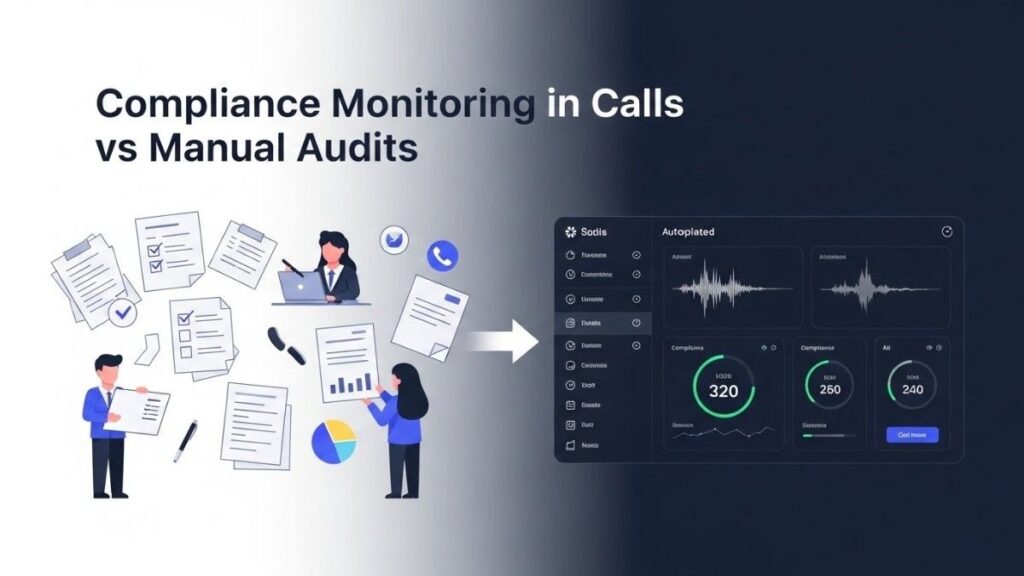
Compliance Monitoring in Calls vs Manual Audits
Introduction
Table of Contents
TL;DR Your contact center handles thousands of calls daily. Each conversation carries potential compliance risks. Regulatory violations cost companies millions in fines annually. The question isn’t whether to monitor compliance. The question is how to do it effectively.
Two primary approaches dominate the market today. Automated compliance monitoring in calls uses technology to track conversations in real time. Manual audits rely on human reviewers examining recorded interactions after they happen. Both methods aim to protect your business from regulatory penalties.
The choice between these approaches impacts your operations significantly. Costs vary dramatically. Detection accuracy differs substantially. Response times range from seconds to weeks. Your industry regulations may favor one method over another.
This blog examines both approaches comprehensively. You’ll discover how each method works in practice. You’ll understand the advantages and limitations of automation versus human review. Most importantly, you’ll learn which strategy fits your specific business needs.
Understanding Call Compliance Requirements
Regulatory bodies create strict rules for customer interactions. Financial institutions must follow TCPA guidelines for telephone communications. Healthcare providers operate under HIPAA privacy requirements. Credit card processing demands PCI DSS compliance.
Each industry faces unique challenges. Banks must verify customer identity before discussing account details. Insurance companies need documented consent for certain communications. Collection agencies follow FDCPA rules about contact times and language.
Recording requirements vary by jurisdiction. Some states require two-party consent for call recording. Others allow single-party notification. International calls introduce additional complexity with GDPR and similar regulations.
Script adherence protects companies from liability. Agents must deliver specific disclosures at designated times. Payment terms require clear explanation. Cancellation policies need proper communication.
Compliance monitoring in calls addresses these varied requirements systematically. The approach you choose determines how well you catch violations. Detection speed affects your ability to prevent recurring problems.
Consumer protection laws keep evolving. New regulations emerge regularly. Your monitoring system must adapt to changing requirements. Flexibility becomes essential for long-term compliance success.
How Traditional Manual Audits Work
Manual auditing follows a straightforward process. Quality assurance teams select random call samples from recordings. Reviewers listen to conversations carefully. They complete evaluation forms based on compliance criteria.
Sample sizes typically remain small due to time constraints. A reviewer might audit three to five calls per agent monthly. Complex calls require 30 minutes or more for thorough review. Mathematical limitations prevent comprehensive coverage.
Scoring rubrics guide the evaluation process. Checklists contain specific compliance items to verify. Did the agent identify themselves properly? Was the required disclosure read verbatim? Did payment terms get explained clearly?
Reviewers document violations in detail. They note timestamps of problematic statements. They categorize severity levels from minor to critical. Reports go to supervisors for corrective action.
Calibration sessions maintain consistency across reviewers. Teams meet regularly to evaluate the same calls. They discuss scoring discrepancies. They align their interpretation of compliance standards.
Feedback loops close the quality improvement cycle. Agents receive coaching on identified issues. Training addresses common violation patterns. Performance metrics track improvement over time.
Manual audits dominated compliance monitoring for decades. The approach works well for small call volumes. Human judgment provides valuable context. Reviewers understand nuance that technology might miss.
Automated Compliance Monitoring Technology
Modern technology transforms compliance oversight fundamentally. Speech analytics engines process every single call automatically. Natural language processing detects specific phrases and keywords. Machine learning identifies violation patterns across conversations.
Real-time monitoring catches problems as they happen. Supervisors receive instant alerts when agents miss required disclosures. Managers can join calls live to provide guidance. Immediate correction prevents compliance breaches from completing.
Compliance monitoring in calls through automation covers 100% of interactions. No conversation escapes review. Statistical sampling becomes unnecessary. Your organization gains complete visibility into agent performance.
Keyword spotting flags regulated terms and phrases. The system highlights when agents discuss payment arrangements. It detects promise of specific outcomes. It identifies prohibited collection language automatically.
Sentiment analysis adds another monitoring layer. Angry customers may indicate service failures. Extremely frustrated callers might file complaints. Emotional escalation often precedes regulatory violations.
Voice biometrics verify speaker identity. The technology confirms the person on the call matches claimed identity. Fraud prevention integrates with compliance efforts. Security and regulatory requirements align seamlessly.
Pattern recognition improves over time. Machine learning algorithms study thousands of compliant conversations. They learn what proper interactions look like. Deviations from established patterns trigger alerts.
Speed and Coverage Comparison
Manual auditing creates inevitable delays. Calls happen on Monday. Reviews occur the following week or later. Violations continue unchecked during this gap. Damage accumulates before anyone identifies the problem.
Sample-based approaches leave blind spots. You audit 5% of calls optimistically. The remaining 95% receive no scrutiny. Systematic violations easily hide in unreviewed conversations. Risk exposure remains dangerously high.
Compliance monitoring in calls delivers immediate detection. Automated systems analyze conversations as they progress. Alerts arrive within seconds of violations. Supervisors intervene before calls conclude.
Complete coverage eliminates statistical guesswork. Every interaction receives identical scrutiny. Rare violations get caught reliably. Frequency analysis becomes genuinely accurate.
Trending analysis happens in real time. Managers spot emerging problems instantly. A new agent misses disclosures repeatedly. The system flags this pattern after three or four calls instead of waiting weeks.
Historical data becomes searchable comprehensively. Investigations pull specific conversation types instantly. Regulatory audits get supporting documentation in minutes. Manual systems require days of digging through archives.
The speed advantage compounds during crises. A compliance breach surfaces publicly. You need to assess exposure immediately. Automated systems scan millions of calls overnight. Manual review would take months.
Accuracy and Consistency Analysis
Human reviewers bring valuable judgment to evaluations. They understand context that rigid rules miss. A technical script deviation might be immaterial to actual compliance. Experienced auditors recognize these distinctions.
Subjectivity creates consistency challenges though. Different reviewers interpret standards differently. Monday morning scores vary from Friday afternoon scores. Fatigue affects judgment quality.
Calibration reduces variability but never eliminates it. Even well-trained teams show scoring discrepancies. Inter-rater reliability studies document this phenomenon. Agreement rates of 80-85% are considered good.
Compliance monitoring in calls through automation provides perfect consistency. The system applies identical criteria to every conversation. Rule-based detection never varies. An agent either speaks the required phrase or doesn’t.
False positives represent automation’s main accuracy challenge. Systems flag conversations that actually comply upon closer review. Background noise triggers keyword matches incorrectly. Supervisors spend time investigating non-issues.
Machine learning reduces false positives over time. Engineers tune detection algorithms based on feedback. Accuracy improves continuously. Modern systems achieve 95%+ precision rates.
False negatives pose risks in both approaches. Manual audits miss violations through oversight or sampling gaps. Automated systems fail to catch creative variations of prohibited language. Hybrid strategies address both failure modes.
Bias affects manual reviews more than automated ones. Unconscious preferences influence human evaluators. Popular agents receive leniency. Unpopular ones face harsher scrutiny. Technology judges all agents equally.
Cost Structure and ROI
Manual audit programs carry obvious labor costs. Quality assurance staff require salaries and benefits. Each reviewer handles limited call volume. Growing your contact center means hiring proportionally more auditors.
Hidden costs add up substantially. Reviewers need ongoing training on regulations. Calibration sessions consume productive time. Technology infrastructure for accessing recordings requires investment.
Opportunity costs deserve consideration too. QA staff could perform other valuable work. Their audit time prevents them from coaching agents directly. Resource allocation involves tradeoffs.
Compliance monitoring in calls through technology requires upfront investment. Software licensing fees vary by call volume. Implementation costs include integration with existing systems. Ongoing maintenance and updates add recurring expenses.
The math favors automation at scale. Manual review costs remain linear with volume. Technology costs grow much more slowly. The breakeven point arrives surprisingly quickly for most organizations.
Direct ROI comes from avoiding violations. A single TCPA violation costs $500 to $1500 per incident. Major breaches result in millions in fines. Preventing one significant penalty justifies years of monitoring investment.
Indirect benefits boost ROI further. Agent productivity improves with real-time feedback. Customer satisfaction increases through better service quality. Employee retention gets better when coaching focuses on genuine issues rather than random samples.
Risk reduction carries immeasurable value. Compliance disasters destroy company reputations. Stock prices plummet after regulatory actions. Brand damage lasts years. Prevention costs far less than recovery.
Implementation Complexity
Manual audit programs start simply. You hire QA staff,create evaluation forms and select calls to review. The operation runs with minimal technical requirements.
Scaling manual operations gets messy fast. More agents require more auditors. Schedule coordination becomes complicated. Maintaining consistency across growing teams challenges management.
Technology deployment demands careful planning. You must integrate with existing call recording systems. CRM platforms need connectivity for complete context. Network infrastructure must handle real-time processing loads.
Compliance monitoring in calls requires accurate configuration. Rules engines need programming to detect specific violations. Keyword lists require comprehensive development. False positive tuning takes iterative refinement.
Change management represents the largest implementation hurdle. Agents resist monitoring technology initially. They fear constant surveillance. They worry about unfair evaluation.
Training requirements differ substantially between approaches. QA staff need deep compliance knowledge for manual review. They must understand every regulation thoroughly. Technology users need different skills.
Supervisors learn to respond to automated alerts. They practice live call intervention. They develop investigation workflows. Technical proficiency becomes more important than regulatory expertise.
Data security and privacy considerations multiply with automation. Systems process sensitive customer information continuously. Storage and access controls must meet strict standards. Compliance monitoring itself must comply with regulations.
Real-Time Intervention Capabilities
Manual audits provide only retrospective insights. You discover problems days or weeks after they occur. Corrective action happens after damage is done. The customer experience already suffered.
Post-call coaching helps future performance. Agents learn from mistakes. They adjust their approach. Improvement happens gradually over subsequent interactions.
Live monitoring through technology changes the game dramatically. Supervisors see compliance risks as calls progress. They can whisper guidance to agents in real time. Critical violations get prevented before completion.
Compliance monitoring in calls enables immediate course correction. An agent forgets the required disclosure. The system alerts the supervisor instantly. The supervisor sends a chat reminder. The agent recovers smoothly.
Customer experience improves through proactive intervention. Escalating calls get supervisor attention immediately. Problems get resolved before customers hang up frustrated. Satisfaction scores improve measurably.
Training opportunities emerge during actual customer interactions. New agents receive guidance on their first few calls. Complex situations get expert support. Learning accelerates dramatically compared to classroom instruction.
Risk mitigation happens at the source. A compliance breach in progress gets stopped. The customer never experiences the violation. Your company avoids the liability entirely.
Documentation benefits accumulate automatically. Every intervention gets logged with context. Performance tracking becomes comprehensive. Coaching conversations reference specific incidents precisely.
Scalability and Growth Management
Small contact centers manage manual audits effectively. Ten agents generate perhaps 2000 calls weekly. A single QA person reviews 100 calls monthly. Coverage reaches 10% or higher.
Growth exposes manual limitations quickly. You hire 50 more agents. Call volume jumps to 12000 weekly. You need five additional QA staff to maintain coverage percentage. Costs escalate proportionally.
Seasonal spikes create impossible situations. Holiday volume doubles or triples temporarily. You can’t hire and train QA staff for short periods. Audit coverage plummets during peak business times.
Compliance monitoring in calls scales elegantly with volume. Software processes the 100th call and the 100000th call equally well. Marginal costs approach zero. Your monitoring capability grows automatically with your business.
Geographic expansion complicates manual programs. New locations require local QA teams. Consistency across sites challenges coordination. Centralized oversight becomes difficult.
Technology centralizes compliance oversight naturally. One team monitors all locations from anywhere. Standards remain uniform across geographies. Management visibility extends enterprise-wide.
Multiple communication channels multiply complexity. Customers reach you via phone, email, chat, and social media. Each channel needs compliance monitoring. Manual approaches struggle with omnichannel coverage.
Integrated platforms monitor all channels through single interfaces. Compliance rules apply consistently everywhere. Reporting consolidates across interaction types. Your compliance posture becomes truly comprehensive.
Regulatory Reporting and Documentation
Regulators demand proof of compliance efforts. Examinations require documented monitoring activities. You must demonstrate systematic oversight. Sampling strategies need statistical justification.
Manual audit trails create paper-heavy documentation. Evaluation forms fill filing cabinets. Spreadsheets track sampling ratios. Evidence compilation takes days during audits.
Report generation happens manually in traditional programs. QA managers compile statistics from individual reviews. Trend analysis requires significant effort. Data accuracy depends on careful record-keeping.
Compliance monitoring in calls produces comprehensive audit trails automatically. Every call analysis gets logged permanently. Detection algorithms document their decision process. Reports generate at the click of a button.
Regulatory reporting becomes straightforward. The system proves you monitor 100% of interactions. Violation detection rates demonstrate program effectiveness. Corrective action tracking shows continuous improvement.
Exception reporting highlights problematic patterns. Which agents need additional training? Which call types generate the most violations? What times of day show elevated risk? Analytics answer these questions instantly.
Historical queries support investigations and audits. Regulators ask about specific customer complaints. You retrieve relevant calls within minutes. Context and compliance evaluation come together seamlessly.
Retention policies get enforced automatically. Regulations require certain retention periods. Manual systems depend on IT to maintain archives. Automated platforms manage retention as part of core functionality.
Agent Performance and Coaching
Manual audits create anxiety among agents. Reviews feel arbitrary due to small sample sizes. An agent might get unlucky with selected calls. One bad day disproportionately affects scores.
Infrequent feedback delays improvement. You review calls monthly. Agents learn about mistakes weeks after occurrence. Memory fades. Context gets forgotten.
Coaching sessions reference calls agents barely remember. The teaching moment loses impact. Behavior change happens slowly. Performance improvement takes longer than necessary.
Compliance monitoring in calls enables targeted coaching. Supervisors address issues immediately after detection. Memory remains fresh. Corrections stick more effectively.
Performance tracking becomes genuinely comprehensive. You see every agent interaction. Outliers become obvious quickly. Top performers get recognition they deserve.
Struggling agents receive help faster. Systems identify training needs from complete data. Intervention happens before problems become habits. Success rates improve across the team.
Gamification opportunities emerge from complete data. Leaderboards show compliance scores. Recognition programs reward consistent performance. Positive reinforcement complements corrective action.
Fairness perceptions improve dramatically. Agents trust systems that evaluate everyone equally. Consistency eliminates favoritism concerns. Morale benefits from transparent assessment.
Industry-Specific Considerations
Financial services face intense regulatory scrutiny. TCPA compliance requires careful attention to consent. Dodd-Frank regulations govern mortgage discussions. Investment conversations must avoid misleading statements.
Healthcare providers operate under HIPAA privacy rules. Protected health information requires special handling. Disclosure authorizations need careful verification. Security breach penalties reach into millions.
Collection agencies navigate FDCPA requirements carefully. Contact time restrictions apply. Language prohibitions prevent harassment. Documentation demands proof of proper procedures.
Compliance monitoring in calls adapts to industry requirements. Financial service platforms include TCPA-specific detectors. Healthcare systems recognize PHI exposure risks. Collection software enforces time-of-day restrictions.
Insurance companies deal with state-specific regulations. Each jurisdiction has unique requirements. Licensing verification varies by location. Quote disclosure language differs regionally.
Retail and ecommerce businesses focus on PCI compliance during payments. Card numbers must receive proper handling. Security procedures require consistent execution. Recording policies differ for payment segments.
Telecommunications providers follow FCC regulations. Service terms need clear explanation. Contract details require specific disclosure. Equipment policies demand proper communication.
Pharmaceutical and medical device companies face FDA promotion rules. Claims about products must align with approved indications. Risk disclosures require careful delivery. Adverse event reporting mandates specific procedures.
Integration with Existing Systems
Manual audit programs exist in isolation often. QA tools stand alone from other operations. Call recordings live in separate systems. CRM data requires manual correlation.
Disconnected systems create workflow inefficiencies. Reviewers toggle between multiple applications. Context requires piecing together information. Time gets wasted on navigation rather than analysis.
Compliance monitoring in calls works best when fully integrated. Modern platforms connect with call recording infrastructure. CRM integration provides customer history during analysis. Ticketing systems link violations to corrective actions.
Workforce management tools receive compliance data. Scheduling considers training needs. Performance management systems incorporate quality scores. Compensation calculations reflect monitoring results.
Analytics platforms aggregate compliance with other metrics. Dashboards show relationships between quality and efficiency. Correlation analysis reveals unexpected patterns. Strategic insights emerge from unified data.
API architectures enable custom integrations. You connect proprietary systems easily. Data flows bidirectionally between platforms. Your technology stack works together harmoniously.
Cloud-based deployments simplify integration. Modern SaaS platforms offer pre-built connectors. Implementation timelines shrink dramatically. Maintenance burden decreases substantially.
Legacy system compatibility challenges both approaches. Older call recording platforms lack modern integration capabilities. Manual processes become workarounds. Technology upgrades may be necessary regardless of monitoring approach.
Data Security and Privacy
Manual audits expose fewer systems to compliance data. Reviewers access recordings on secure workstations. Information stays within controlled environments. Attack surface remains relatively limited.
Human access creates its own risks though. Reviewers might screenshot sensitive information. They could share details inappropriately. Insider threats remain difficult to prevent completely.
Compliance monitoring in calls processes data extensively. Information flows through multiple system components. Networks carry sensitive conversations. Storage systems accumulate vast amounts of personal data.
Encryption protects data in transit and at rest. Modern platforms employ bank-grade security. Access controls limit information exposure. Audit trails track every data interaction.
Anonymization features protect customer privacy. Personal identifiers get masked during analysis. Only authorized staff access unredacted information. Privacy and compliance monitoring balance appropriately.
Regulatory compliance for monitoring systems requires attention. GDPR affects European customer data. CCPA governs California residents. International operations navigate multiple privacy regimes.
Vendor security becomes critical with cloud platforms. You trust providers with sensitive information. Due diligence includes security audits. Certifications like SOC 2 demonstrate commitment.
Data residency requirements affect deployment options. Some regulations mandate in-country data storage. Cloud architecture must support geographic constraints. Compliance with monitoring compliance gets recursive.
Hybrid Approaches and Best Practices
Neither pure automation nor pure manual review represents the optimal strategy. The best compliance programs combine both approaches strategically. Technology handles volume and consistency. Humans provide judgment and context.
Automated compliance monitoring in calls performs initial screening. Systems flag potential violations. They prioritize issues by severity. They route items requiring human review.
Calibration takes on new meaning in hybrid models. Teams validate system accuracy regularly. They tune detection algorithms based on findings. They ensure technology and human judgment align.
Sampling strategies shift with automation. Random sampling becomes unnecessary for routine checks. Targeted sampling addresses edge cases. Review efforts focus where they add most value.
Continuous improvement drives hybrid program success. Technology learns from human corrections. Rules engines get updated based on discoveries. Automation capabilities expand over time.
Cost optimization happens naturally. Expensive human resources concentrate on high-value activities. Technology handles repetitive screening work. Overall program costs decrease while coverage improves.
Risk-based monitoring allocates resources intelligently. High-risk call types receive extra scrutiny. Proven performers face lighter oversight. Resources flow to areas of greatest concern.
Common Implementation Mistakes
Underestimating change management needs sinks many technology projects. You buy sophisticated compliance monitoring tools. You deploy them without proper communication. Agents revolt. Supervisors resist. The investment fails.
Inadequate rule configuration produces useless results. Generic keyword lists generate endless false positives. Supervisors ignore alerts. The system becomes ignored.
Compliance monitoring in calls requires careful tuning. You must customize detection rules for your specific needs. Industry requirements differ. Company policies vary. Configuration demands significant effort.
Insufficient training dooms both automated and manual programs. QA staff need deep skills. Supervisors require alert response training. Agents deserve clear performance expectations.
Neglecting ongoing maintenance causes system degradation. Regulations change. Business processes evolve. Your monitoring rules become outdated quickly.
Failing to act on findings wastes all monitoring efforts. You discover violations. You document problems. Nothing changes. Agents continue making the same mistakes.
Focusing solely on compliance misses broader value. Monitoring data reveals customer pain points. Call patterns show process inefficiencies. Limiting use to compliance wastes potential insights.
Choosing tools based on price alone creates regrets. Cheap solutions lack critical features. Implementation difficulties multiply. Total cost of ownership exceeds expectations.
Measuring Program Success
Violation rates provide the most direct success metric. Are problems increasing or decreasing? Which violation types persist? What trends emerge over time?
Compliance monitoring in calls makes measurement comprehensive. You track every interaction type. Statistical significance comes from large samples. Trends appear clearly in the data.
Regulatory outcomes demonstrate program effectiveness. Examination results improve. Fines and penalties decrease. Regulatory relationships strengthen.
Customer satisfaction correlates with compliance often. Proper disclosures build trust. Professional conduct creates positive experiences. Quality monitoring supports satisfaction goals.
Agent performance metrics show program impact. Coaching based on complete data improves faster. Turnover decreases when feedback feels fair. Employee engagement rises with clear expectations.
Operational efficiency gains justify monitoring investment. Real-time intervention reduces handle time. Problem resolution happens on first calls. Repeat contacts decrease.
Cost avoidance quantifies financial benefits. Calculating prevented fines requires estimation. Conservative assumptions still show substantial value. Risk reduction alone justifies program costs.
Program maturity indicators track long-term progress. Coverage percentages increase. Detection accuracy improves. Response times decrease. Continuous improvement becomes measurable.
Choosing the Right Approach
Your call volume influences the decision significantly. Small centers with hundreds of daily calls manage manual audits acceptably. Large operations with thousands of interactions need automation.
Regulatory risk exposure matters enormously. Highly regulated industries justify greater monitoring investment. Potential penalties drive ROI calculations. Industries with lower regulatory burden have more flexibility.
Compliance monitoring in calls makes sense when violation costs are high. A single TCPA fine might cost $50000. Healthcare privacy breaches run into millions. Prevention investment scales to risk.
Budget constraints affect options obviously. Manual programs require ongoing labor costs. Technology demands upfront capital. Your financial situation determines feasible approaches.
Technical infrastructure readiness enables or prevents automation. Modern call center technology integrates easily. Legacy systems create obstacles. Infrastructure upgrades might be prerequisites.
Staff capabilities influence implementation success. Do you have people who can configure complex systems? Can your team manage technology? Skills availability matters.
Growth trajectory points toward automation for scaling businesses. If you plan significant expansion, manual approaches create future problems. Building scalable foundations prevents painful transitions later.
Competitive positioning considerations emerge in some industries. Best-in-class compliance creates market advantages. Customer trust builds on operational excellence. Monitoring choices affect brand reputation.
Future Trends and Innovations
Artificial intelligence advances promise dramatic improvements. Machine learning models understand conversation context better. Natural language processing catches nuanced violations. Accuracy improves while false positives decline.
Predictive compliance emerges as next-generation capability. Systems identify agents at risk of violations before problems occur. Behavioral patterns predict future performance. Proactive intervention prevents issues.
Compliance monitoring in calls expands beyond voice. Video channels require monitoring. Screen sharing needs compliance checks. Omnichannel coverage becomes truly comprehensive.
Emotion AI adds psychological insight. Technology detects customer distress. Agent stress levels become visible. Emotional intelligence augments compliance monitoring.
Blockchain technology may transform audit trails. Immutable records prove compliance activities. Regulatory reporting becomes irrefutable. Trust increases through transparency.
Real-time translation enables global monitoring. Multilingual contact centers get unified oversight. Compliance rules apply across languages. International operations standardize more easily.
Augmented reality training uses monitoring data. Agents practice in simulated environments. Realistic scenarios come from actual violations. Learning accelerates through immersive experiences.
Privacy-preserving technologies enable monitoring while protecting data. Federated learning trains algorithms without centralizing information. Homomorphic encryption analyzes without decryption. Privacy and compliance goals align better.
Read more:-AI Personalized Callflows vs Traditional IVR Systems
Conclusion

Compliance monitoring in calls represents a critical business function. Regulatory violations carry severe consequences. Financial penalties damage profitability. Reputation harm affects long-term viability. Your monitoring approach directly impacts risk exposure.
Manual audits served organizations well for decades. Human judgment provides valuable insight. Context understanding remains difficult for technology. Small operations still benefit from traditional approaches.
Technology transforms compliance oversight fundamentally. Automation covers every interaction comprehensively. Real-time detection prevents violations before completion. Scalability supports growing organizations effectively.
The choice isn’t always binary. Hybrid approaches combine the best of both methods. Technology handles volume and consistency. Humans provide judgment and nuance. Strategic combinations optimize results.
Your specific circumstances determine the right path. Call volume matters significantly. Regulatory risk levels influence decisions. Budget realities constrain options. Technical capabilities enable or prevent automation.
Starting somewhere matters more than perfect initial choices. Manual programs beat no monitoring at all. Basic automation exceeds random sampling. Iterative improvement develops over time.
Compliance monitoring in calls will continue evolving rapidly. Artificial intelligence advances steadily. Integration capabilities expand. Costs decrease while functionality improves.
Your competitive position depends partly on compliance excellence. Customers trust companies that operate professionally. Employees thrive in well-managed environments. Regulators reward systematic oversight efforts.
Take action on monitoring today. Assess your current approach honestly. Identify gaps and vulnerabilities. Evaluate options appropriate for your scale. Invest in solutions that match your needs.
The cost of inaction exceeds any monitoring investment. A single major violation justifies years of program spending. Risk management demands systematic attention. Your business success depends on getting compliance right.