
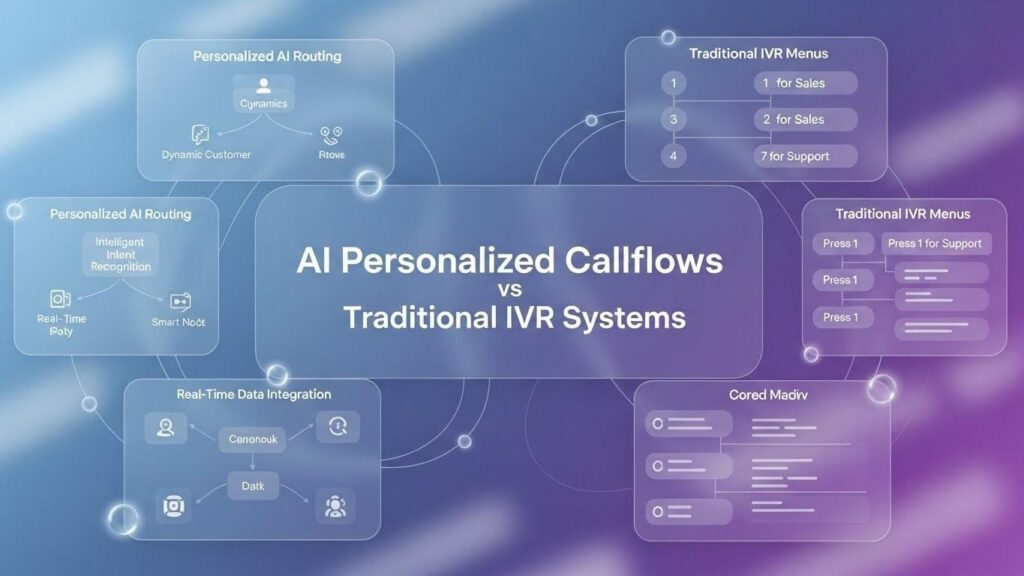
AI Personalized Callflows vs Traditional IVR Systems
Introduction
Table of Contents
TL;DR Phone systems shape customer experiences more than most business leaders realize. The technology routing incoming calls determines whether customers feel valued or frustrated. This fundamental choice between old and new approaches impacts every customer interaction.
AI personalized callflows represent a revolutionary departure from traditional phone systems. These intelligent systems adapt to individual callers dynamically. Each customer receives a unique experience tailored to their specific needs and history.
Traditional IVR systems have frustrated customers for decades. Press one for sales, press two for support, press three for billing. These rigid menu structures waste time and test patience. Nearly everyone has experienced the annoyance of navigating endless phone menus.
Modern customers expect personalization across all business interactions. They receive customized recommendations on websites and targeted ads on social media. Phone calls should offer the same level of individual attention. Outdated IVR systems fail to meet these elevated expectations.
Understanding Traditional IVR Technology
Interactive Voice Response systems emerged in the 1970s as groundbreaking technology. Organizations could finally automate basic phone interactions without human operators. Touch-tone technology enabled customers to navigate menu options independently.
Traditional IVR operates through fixed decision trees programmed in advance. Developers map out every possible path customers might take. These predetermined routes cannot adapt to individual circumstances. Every caller receives identical menu options regardless of their needs.
Menu depth represents a persistent problem with conventional IVR. Customers often drill through five or six levels to reach the right department. Each level adds time and frustration to the call experience. Many callers abandon calls before reaching their destination.
Voice recognition in traditional systems follows rigid patterns. Customers must speak exact phrases the system expects. Natural conversation remains impossible. Slight variations in wording cause recognition failures.
Integration limitations hamper traditional IVR effectiveness. These systems rarely connect to customer databases or CRM platforms. Representatives lack context about caller history when customers finally reach them. Every call starts from zero regardless of previous interactions.
Maintenance of traditional IVR requires constant manual updates. Menu changes demand programming work and extensive testing. Product launches necessitate revising multiple menu paths. These updates cost time and money while introducing error risks.
Scalability challenges emerge as businesses grow. Adding new departments or services complicates existing menu structures. Systems become unwieldy mazes that confuse customers and staff alike.
How AI Personalized Callflows Work
AI personalized callflows use machine learning to understand caller intent immediately. Natural language processing interprets what customers say in their own words. Rigid menu navigation becomes unnecessary. Customers simply state their needs conversationally.
Caller identification happens automatically through phone number recognition. Systems access customer records instantly when calls connect. Purchase history, previous interactions, and account status inform routing decisions. This context enables truly personalized experiences.
Intent detection determines what customers need within seconds of speaking. Advanced algorithms analyze words, tone, and context simultaneously. The system identifies whether callers need support, want to make purchases, or have billing questions. Routing happens based on actual needs rather than menu selections.
Dynamic routing adjusts paths based on real-time conditions. AI personalized callflows consider current wait times across departments. They evaluate agent expertise and availability. Customers connect with the best available resource for their specific situation.
Predictive capabilities anticipate customer needs before explicit statements. Recent purchase patterns suggest likely inquiry types. Account status indicators reveal probable call reasons. Proactive routing reduces conversation time substantially.
Continuous learning improves system performance with every interaction. Machine learning models identify successful routing patterns. They recognize when customers receive suboptimal experiences. Self-optimization happens automatically without manual programming.
Omnichannel integration creates seamless experiences across touchpoints. AI personalized callflows reference recent website visits and chat interactions. Customers never repeat information they provided through other channels. True continuity emerges across the entire customer journey.
Key Differences in Customer Experience
Wait times differ dramatically between traditional and AI-powered systems. Conventional IVR forces every caller through identical menu structures. AI personalized callflows route customers instantly based on recognized needs. Average time to reach appropriate assistance drops by 60-70%.
Frustration levels decrease substantially with intelligent routing. Customers avoid the anger of pressing wrong menu options. They skip the irritation of listening to irrelevant choices. Natural conversation feels respectful rather than bureaucratic.
Personalization depth separates modern systems from legacy technology. Traditional IVR treats every caller identically. AI personalized callflows recognize individual customers and adapt accordingly. VIP customers receive priority routing automatically. Frequent callers skip unnecessary verification steps.
Problem resolution speeds improve when systems route intelligently. Customers reach specialists qualified for their specific issues immediately. Traditional IVR often connects callers to generalists who transfer them repeatedly. Direct routing eliminates these wasteful transfers.
Accessibility increases for customers with disabilities or language barriers. AI understands natural speech patterns better than rigid IVR commands. Multilingual capabilities happen seamlessly. Elderly callers who struggle with complex menus navigate AI systems easily.
Brand perception improves when phone systems demonstrate sophistication. Customers judge companies by every interaction. Modern AI personalized callflows signal innovation and customer focus. Outdated IVR suggests companies don’t prioritize experience.
Repeat call reduction occurs when AI routes accurately the first time. Customers who reach the wrong department often call back multiple times. Intelligent routing prevents these repeated attempts. First-call resolution rates climb 40-50% typically.
Technical Architecture Comparison
Processing power requirements differ enormously between systems. Traditional IVR runs on basic servers with minimal computing needs. AI personalized callflows demand substantial processing capabilities. Cloud infrastructure typically handles these requirements most efficiently.
Data integration complexity shows stark contrasts. Legacy IVR systems operate in isolation from other business systems. Modern AI requires connections to CRM, billing, inventory, and analytics platforms. This integration enables contextual decision-making.
Programming approaches diverge fundamentally. Traditional IVR uses fixed scripts written by developers. AI personalized callflows employ machine learning models that train on data. Configuration replaces traditional programming in many scenarios.
Natural language understanding engines power modern callflows. These sophisticated systems parse human speech into actionable insights. Traditional IVR relies on simple speech recognition or touch-tone input. The technological gap spans generations.
Real-time analytics drive AI routing decisions. Systems evaluate multiple data points simultaneously during call processing. Traditional IVR follows predetermined paths without analysis. This analytical capability enables dynamic optimization.
API architecture enables AI system flexibility. Modern platforms connect to various services through standardized interfaces. Traditional IVR often requires custom integration work. Flexibility accelerates deployment and enables continuous improvement.
Latency considerations affect user experience significantly. AI processing must happen in milliseconds to feel instantaneous. Traditional IVR responds quickly due to simplicity. Modern infrastructure ensures AI matches this responsiveness.
Implementation Costs and ROI Analysis
Initial investment in AI personalized callflows exceeds traditional IVR substantially. Licensing fees for AI platforms run higher than basic IVR software. Implementation services cost more due to integration complexity. Typical projects require $50,000-$200,000 depending on organization size.
Infrastructure costs vary based on deployment model. Cloud-based AI solutions minimize upfront hardware expenses. On-premises deployments require significant server investments. Most organizations choose cloud options for flexibility and cost efficiency.
Ongoing operational expenses show interesting patterns. AI licensing typically uses per-minute or per-call pricing models. Traditional IVR involves fixed license fees regardless of usage. AI costs scale with volume while IVR remains constant.
Maintenance expenses favor AI systems over time. Traditional IVR requires manual updates for every menu change. AI personalized callflows adapt automatically through machine learning. Programming costs decrease dramatically with intelligent systems.
ROI calculations must account for multiple benefit categories. Labor savings from reduced call handling time represent obvious gains. Customer satisfaction improvements drive retention and lifetime value increases. These softer benefits often exceed direct cost savings.
Payback periods typically run 12-18 months for AI implementations. Organizations handling high call volumes recover investments faster. Smaller operations may need 24-36 months for full payback. The long-term value proposition remains compelling regardless.
Opportunity costs of delaying AI adoption merit consideration. Competitors implementing AI personalized callflows gain immediate advantages. Customer expectations rise as more companies deploy intelligent systems. Waiting becomes increasingly expensive.
Performance Metrics and Analytics
Call completion rates reveal system effectiveness clearly. AI personalized callflows achieve 85-95% completion rates typically. Traditional IVR sees 60-75% of callers reaching their intended destination. Abandonment rates tell the inverse story equally dramatically.
Average handle time measurements show substantial improvements. Calls routed through AI systems complete 30-40% faster on average. Agents receive context enabling quicker problem resolution. Traditional IVR provides no context requiring longer interactions.
First-call resolution metrics demonstrate quality differences. AI routing connects customers to qualified specialists immediately. Traditional IVR often requires multiple transfers. FCR rates improve from 70% to 90%+ with intelligent systems.
Customer satisfaction scores increase measurably with AI deployment. CSAT ratings typically rise 15-25 percentage points. Net Promoter Scores show similar improvements. Customers appreciate efficient routing and personalized attention.
Agent productivity gains compound efficiency benefits. Representatives handle more calls when AI routes appropriately. They spend less time gathering information AI already collected. Productivity increases of 25-35% occur commonly.
Cost per call calculations favor AI personalized callflows despite higher technology costs. Faster resolution and reduced transfers lower overall expenses. Organizations see 20-30% cost per contact reductions. These savings continue accumulating over time.
Revenue impact from improved experiences shows in retention metrics. Customer churn decreases when phone interactions improve. Lifetime value increases proportionally. These revenue effects often exceed cost savings substantially.
Customization and Flexibility Capabilities
Business rule configuration allows rapid adaptation to changing needs. AI personalized callflows adjust routing logic through interface changes. Traditional IVR requires programming for rule modifications. Business users can manage AI systems directly.
Seasonal variations get handled automatically by intelligent systems. Holiday shopping periods trigger adjusted routing priorities. Tax season in financial services changes call patterns predictably. AI adapts to these cyclical patterns without manual intervention.
Product launch support happens seamlessly with AI systems. New offerings get incorporated into routing logic instantly. Traditional IVR needs menu restructuring and testing. AI personalized callflows reference product databases dynamically.
Geographic routing considers caller location automatically. Systems route to local branches or regional specialists. Traditional IVR requires callers to select their region manually. Location-aware routing saves time and improves accuracy.
Language detection happens automatically in multilingual environments. AI identifies customer language from initial speech. Routing to appropriate language specialists occurs instantly. Traditional IVR forces language selection before any service.
VIP customer treatment gets implemented elegantly through AI. High-value customers receive priority routing without special numbers. The system recognizes them automatically and adjusts accordingly. Traditional IVR treats all callers identically unless they have separate contact numbers.
A/B testing capabilities enable continuous optimization. Organizations experiment with different routing strategies systematically. Performance data reveals which approaches work best. Traditional IVR makes testing expensive and time-consuming.
Integration with CRM and Business Systems
Customer data synchronization happens in real-time with modern systems. AI personalized callflows access current account information during calls. Purchase history, service tickets, and preferences inform routing decisions. Traditional IVR operates blind to customer context.
Salesforce integration enables sophisticated routing logic. Systems reference opportunity stages, lead scores, and account ownership. Sales calls route to appropriate representatives automatically. Traditional IVR cannot access CRM data meaningfully.
Support ticket systems connect seamlessly with AI callflows. Customers calling about open tickets route to assigned technicians. Context from tickets appears to agents before they answer. Traditional IVR knows nothing about support history.
E-commerce platform integration creates powerful capabilities. Recent cart abandonments trigger special handling. High-value orders receive priority attention. AI personalized callflows reference order status during routing decisions.
Marketing automation platforms inform call prioritization. Recent email engagement or campaign responses influence routing. Hot leads receive immediate attention from sales specialists. Traditional IVR treats all sales inquiries identically.
Analytics platforms consume callflow data for comprehensive reporting. Call patterns correlate with other customer behaviors. Organizations gain insights impossible with traditional IVR. Data-driven optimization becomes standard practice.
ERP system connections enable sophisticated business logic. Inventory availability affects product inquiry routing. Account status in billing systems determines collection call handling. AI personalized callflows leverage enterprise data comprehensively.
Handling Complex Customer Journeys
Multi-step problems get managed more effectively by AI systems. Customers need several departments to resolve certain issues. AI personalized callflows orchestrate these journeys intelligently. Traditional IVR forces customers to navigate manually between departments.
Callback functionality preserves customer time valuably. Long hold times trigger offers to call customers back. Queue position gets maintained without staying on hold. Traditional IVR requires customers to wait or hang up.
Cross-sell opportunities emerge naturally from customer data analysis. Purchase patterns suggest relevant additional products. AI routes interested customers to sales specialists. Traditional IVR misses these revenue opportunities entirely.
Escalation paths work smoothly when AI manages routing. Frustrated customers get directed to specialized support teams. Supervisor requests get honored appropriately. Traditional IVR often makes escalation difficult.
Appointment scheduling integrates into callflow logic seamlessly. Customers calling to book appointments skip general queues. They connect directly to scheduling specialists. AI personalized callflows reference calendar systems automatically.
Payment processing happens securely within intelligent callflows. Customers can pay bills without speaking to agents. Account information gets verified automatically. Traditional IVR handles payments awkwardly at best.
Survey deployment occurs naturally at call conclusion. AI determines appropriate survey questions based on interaction type. Response rates increase when surveys feel relevant. Traditional IVR uses generic surveys poorly.
Security and Compliance Considerations
Authentication methods differ significantly between systems. AI personalized callflows use voice biometrics for secure identification. Customers verify identity through natural speech. Traditional IVR relies on passwords or account numbers exclusively.
PCI compliance requirements affect payment processing design. AI systems can tokenize sensitive data automatically. Agents never hear credit card numbers during transactions. Traditional IVR struggles with secure payment collection.
TCPA regulations governing automated calls apply to both systems. AI personalized callflows log consent more comprehensively. Traditional IVR typically records less detailed compliance data. Proper documentation protects against regulatory issues.
Call recording policies work more sophistically with AI. Systems can pause recording during sensitive information exchange. Selective recording reduces storage costs and privacy risks. Traditional IVR typically records entire calls or none.
Data privacy regulations like GDPR impose strict requirements. AI personalized callflows handle customer data with granular controls. Access restrictions and data retention happen automatically. Traditional IVR offers less sophisticated privacy management.
Audit trails provide detailed compliance documentation. Every routing decision and data access gets logged. Organizations can demonstrate compliance easily. Traditional IVR typically offers limited audit capabilities.
Fraud detection happens in real-time with AI systems. Unusual patterns trigger additional verification. Security breaches get prevented before damage occurs. Traditional IVR lacks sophisticated fraud detection.
Industry-Specific Applications
Healthcare organizations leverage AI personalized callflows for appointment management. Patients reach appropriate departments based on chief complaints. Urgent symptoms trigger nurse triage routing. Traditional IVR forces patients through confusing department menus.
Financial services firms route calls based on account types and values. Wealth management clients reach dedicated advisors. Routine banking calls get automated efficiently. Traditional IVR cannot differentiate customer value automatically.
Retail companies handle order inquiries through intelligent routing. Recent purchasers asking questions connect to order specialists. Returns and exchanges route to appropriate teams. AI personalized callflows reference order management systems automatically.
Insurance providers manage claims through sophisticated callflows. Active claim status determines routing priorities. New claims get directed to intake specialists. Traditional IVR treats all claims callers identically.
Telecommunications companies troubleshoot service issues intelligently. Network outages trigger automatic status updates. Account-specific problems route to technical specialists. AI personalized callflows reduce support call volumes substantially.
Travel industry applications route based on trip status and timing. Customers with imminent departures receive priority attention. Booking inquiries route to sales specialists. Traditional IVR cannot access reservation systems meaningfully.
Education institutions direct calls based on caller role. Prospective students reach admissions departments. Current students connect to appropriate support services. AI personalized callflows understand academic calendars automatically.
Migration Strategies from Traditional IVR
Phased approaches minimize disruption during transitions. Organizations typically migrate one department or call type initially. Success with pilot programs builds confidence for broader deployment. Attempting complete replacement immediately creates unnecessary risk.
Parallel operation allows comparison testing. AI personalized callflows handle some calls while IVR continues operating. Performance metrics demonstrate AI superiority concretely. Side-by-side operation convinces skeptical stakeholders.
Agent training prepares staff for new system interactions. Representatives learn how AI routes calls to them. Understanding context transfer improves their effectiveness. Proper training ensures smooth adoption.
Customer communication manages expectations during transitions. Notifications about improved phone systems set positive expectations. Customers appreciate knowing about service enhancements. Clear communication prevents confusion during changeover.
Fallback procedures protect service continuity. Technical issues with AI trigger reversion to traditional IVR. These safety nets prevent service disruptions. Customers remain unaware of backend switching.
Data migration ensures AI has necessary information. Customer records, product catalogs, and business rules transfer to new systems. Clean data enables effective AI personalization. Poor data quality undermines AI advantages.
Performance monitoring during migration identifies issues quickly. Close observation during early deployment catches problems before they spread. Rapid response to issues prevents negative customer experiences.
Future Trends and Innovations
Conversational AI will make phone systems feel completely natural. Future AI personalized callflows will conduct truly human-like conversations. Customers will forget they’re speaking with machines. This naturalness will eliminate all IVR frustrations.
Predictive routing will anticipate customer needs before they speak. Systems will analyze calling patterns and account status proactively. Customers will hear “I see you’re calling about your recent order” immediately. Proactive service will feel almost magical.
Emotional intelligence capabilities will detect caller sentiment accurately. Frustrated customers will route to specialists trained in de-escalation. Excited customers speaking with sales will reach enthusiastic representatives. Emotional matching will improve outcomes substantially.
Visual IVR integration will create omnichannel experiences. Smartphone screens will display menu options while AI processes voice. Customers will choose interaction modalities freely. Flexibility will accommodate all preferences.
Voice commerce will enable transactions within callflows seamlessly. Customers will complete purchases during phone conversations naturally. AI personalized callflows will handle payment processing securely. Phone channels will become revenue generators.
Augmented reality support will enhance troubleshooting. Customers will share camera views while receiving phone guidance. Visual and voice channels will work together. Complex technical issues will resolve faster.
Blockchain verification may secure caller authentication. Distributed ledger technology could verify identities without centralized databases. Privacy protections will increase substantially. Security and convenience will improve simultaneously.
Read More:-Top Phone Automation Trends Transforming Sales Teams
Conclusion
The comparison between AI personalized callflows and traditional IVR reveals clear winners. Modern intelligent systems outperform legacy technology across every meaningful metric. Customer satisfaction, operational efficiency, and business outcomes all favor AI approaches.
Traditional IVR served businesses adequately for decades. These systems represented meaningful progress when they first emerged. Customer expectations have evolved far beyond what rigid menus can deliver. Continuing with outdated technology damages competitiveness.
AI personalized callflows deliver experiences customers expect in modern business. Personalization, efficiency, and intelligence characterize these systems. Organizations deploying AI gain immediate advantages over competitors. These advantages compound as systems learn and improve.
Implementation costs represent investments rather than expenses. ROI calculations clearly favor AI despite higher initial outlays. Cost savings, revenue gains, and competitive positioning justify investments. Delaying adoption becomes increasingly expensive.
Customer loyalty depends on experience quality across all touchpoints. Phone interactions remain critical despite digital channel growth. AI personalized callflows ensure phone channels enhance rather than harm relationships. Every call becomes an opportunity to impress.
The future belongs to organizations embracing intelligent automation. AI personalized callflows represent just the beginning of customer service transformation. Early adopters establish positions competitors struggle to match. The time to act is now.
Your choice between AI personalized callflows and traditional IVR defines your customer experience strategy. This decision signals your commitment to innovation and service excellence. Make the choice that positions your organization for sustained success.