
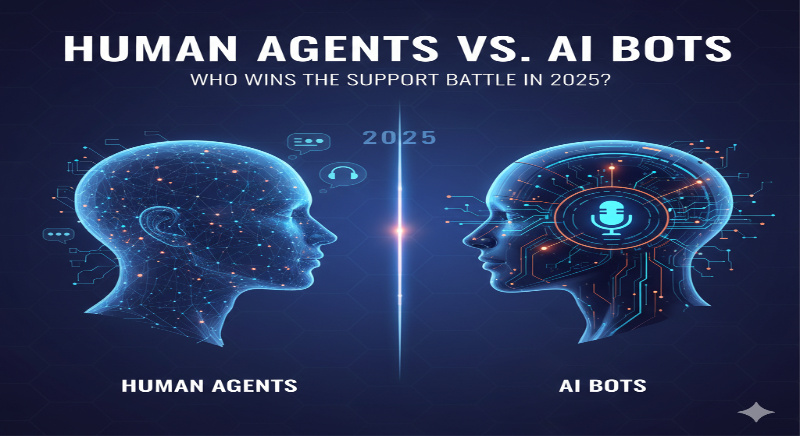
Human Agents vs. AI Bots: Who Wins the Support Battle in 2025?
Introduction
Table of Contents
Customer support sits at the core of every business relationship.Get it right and customers stay loyal. Get it wrong and they leave and talk about it.
The question every business leader faces in 2025 is no longer whether to use AI in support. The question is how to balance it with human talent.
Human agents vs AI bots has become the defining debate in customer experience strategy.
Both sides have genuine strengths. Both carry real limitations. The winner of this battle depends entirely on what your customers need and what your business demands.
This guide breaks down every critical dimension of that comparison. You will walk away knowing exactly where each option wins and how to build a strategy that uses both to maximum effect.
The State of Customer Support in 2025
Customer expectations reached an all-time high in 2025.
Consumers expect immediate responses. They want accurate answers. They demand consistent service across every channel they use.
A 2024 Salesforce report found that 88% of customers say the experience a company provides matters as much as its products.
That number reflects a fundamental shift. Service is no longer a support function. It is a competitive weapon.
Human agents vs AI bots defines how that weapon gets deployed.
AI adoption in customer service accelerated sharply between 2022 and 2025. Chatbots, voice AI, and automated ticketing systems now handle billions of customer interactions every year.
Major enterprises report that AI handles 40 to 70 percent of their total support volume. That figure rises every quarter.
At the same time, customer satisfaction with pure AI support remains inconsistent. Complex problems, emotional situations, and unusual requests still challenge automated systems.
Human agents remain irreplaceable for high-stakes and high-emotion interactions. Their value has not diminished. It has shifted.
The 2025 support landscape demands a clear-eyed view of what each resource does best. Guessing wrong costs businesses customers and revenue.
Understanding human agents vs AI bots at a deep level is not just an operations question. It is a strategic survival question.
What AI Bots Do in Modern Customer Support
AI bots in customer support range from simple rule-based chatbots to sophisticated large language model systems.
Rule-based bots follow decision trees. They ask structured questions and deliver scripted responses based on user input.
LLM-powered bots use natural language processing to understand context, interpret intent, and generate conversational responses.
The gap between these two categories matters enormously. A rule-based bot frustrates customers with rigid menus. An LLM-powered bot can hold a natural, flowing conversation.
Modern AI bots handle order status queries, password resets, FAQ responses, appointment scheduling, payment processing, and basic troubleshooting.
They work 24 hours a day without breaks,scale to handle thousands of simultaneous conversations,cost a fraction of equivalent human headcount.
In the human agents vs AI bots debate, AI wins every cost and scale argument.
A human agent handles 8 to 12 conversations per hour under ideal conditions. An AI bot handles thousands per second without performance degradation.
Response time is another clear advantage. AI bots answer instantly. Human agents make customers wait.
Most consumers wait on hold for an average of 11 minutes when contacting a support team. AI bots eliminate that wait entirely.
AI bots also deliver perfect consistency. Every customer receives the same quality of service regardless of time, day, or volume.
Human variability disappears. Mood, fatigue, and training gaps stop affecting customer outcomes.
What Human Agents Do That AI Cannot
Emotional Intelligence and Empathy
Human agents read emotional cues. They hear frustration in a voice. They sense anxiety in word choice.
A customer calling about a fraudulent charge on a recently deceased parent’s account needs compassion. An AI bot delivers a transaction dispute form.
Emotional intelligence is not a feature you add to a bot. It emerges from years of human experience, social learning, and genuine care.
High-stakes emotional interactions almost always require a human agent. No AI system in 2025 fully replicates this capacity.
The human agents vs AI bots comparison on emotional intelligence is not close. Humans win decisively.
Complex Problem-Solving
Novel problems expose AI limitations fast.
A customer with an issue that falls outside the training data triggers confusion in an AI system. The bot loops, deflects, or gives a wrong answer.
Human agents synthesize information creatively. They draw on experience, judgment, and intuition to solve problems they have never seen before.
A skilled agent handles edge cases, multi-part problems, and contradictory information with ease.
AI bots excel at problems that fit known patterns. Human agents excel at problems that break them.
Relationship Building and Retention
Long-term customer relationships often hinge on a single memorable interaction with a human agent.
A support agent who goes out of their way to solve a problem creates loyalty that survives price increases and competitor offers.
That emotional bond simply does not form through bot interactions for most customers.
Enterprise B2B relationships depend heavily on human contact. A dedicated account manager with genuine knowledge of a client’s business creates switching costs no AI can replicate.
Ethical and Sensitive Judgments
Some support situations require ethical judgment.
A customer disclosing a crisis situation needs a human who can escalate appropriately and with care.
Legal nuances, privacy concerns, and regulatory compliance sometimes require judgment calls that fall outside any bot’s parameters.
Human agents carry moral accountability. That accountability protects customers and protects businesses.
Head-to-Head: Human Agents vs AI Bots Across Key Metrics
Response Speed
AI bots respond in milliseconds. Human agents take minutes during low volume and much longer during peak demand.
For routine inquiries, customers prefer speed. A bot that answers in two seconds beats an agent who answers in twelve minutes.
Speed is the clearest advantage AI holds in the human agents vs AI bots comparison.
First Contact Resolution Rate
First contact resolution measures how often a support interaction resolves a customer’s issue on the first attempt.
Well-trained human agents consistently outperform AI on first contact resolution for complex issues.
AI bots achieve high first contact resolution on simple, well-defined problems. Their resolution rates drop sharply as complexity increases.
The 2025 industry average for human agent first contact resolution sits at 74%. AI bots achieve similar rates on simple issues but fall to under 40% on multi-step or ambiguous problems.
Customer Satisfaction Scores
Customer satisfaction scores reveal a nuanced picture.
For simple, fast transactions, AI bots score as well as or better than human agents. Customers value speed and accuracy on straightforward requests.
For complex issues, emotional situations, and high-stakes interactions, human agents earn significantly higher satisfaction scores.
A 2024 Gartner study found that customers who reached a human agent for complex issues scored satisfaction 31 points higher than those handled only by AI.
The human agents vs AI bots satisfaction gap narrows on simple queries and widens on complex ones.
Cost Per Interaction
Cost per interaction is where AI wins most decisively.
A human agent interaction in a North American call center costs an average of $8 to $15.
An AI bot interaction costs $0.10 to $0.80 depending on platform and complexity.
For a business handling 100,000 support interactions per month, the cost difference runs into millions of dollars annually.
The financial case for AI at scale is overwhelming for high-volume support environments.
Availability and Coverage
Human agents work scheduled shifts. They call in sick, take holidays, need training time.
AI bots work every hour of every day without interruption. They scale instantly during traffic spikes. They never go on leave.
Global businesses with customers across time zones find AI availability essential.
After-hours and weekend support from AI bots captures customer interactions that would otherwise go unanswered.
Scalability Under Pressure
A product recall, a service outage, or a viral complaint can flood a support team overnight.
Human agents require weeks of hiring and training to scale. During that delay, customer experience suffers.
AI bots scale instantly. Add capacity through platform settings, not headcount.
Crisis scalability is one of the strongest operational arguments for AI in the human agents vs AI bots debate.
Where Human Agents Win Outright in 2025
High-Value Customer Retention
Retaining a customer with a $50,000 annual contract requires human judgment and relationship skills.
An AI bot can collect feedback. Only a human can negotiate, empathize, and craft a personalized solution that keeps a key account.
Enterprise customer success teams and high-value account managers deliver ROI that no AI bot comes close to matching.
In the human agents vs AI bots calculation, human agents generate disproportionate returns at the top of the customer value curve.
Sensitive and Regulated Industries
Healthcare, financial services, legal advice, and insurance involve privacy laws, ethical obligations, and regulatory compliance.
A patient asking about their diagnosis needs a trained professional, not a language model.
A customer disputing a financial product needs a licensed representative who understands compliance obligations.
Regulated industries require human judgment as a legal and ethical necessity.
Crisis and Escalation Management
When AI bots fail, a human must step in. That escalation path needs to be seamless.
Crisis management, negative media situations, and regulatory investigations all demand human leadership in the support function.
Human agents manage escalations with contextual awareness and strategic judgment.
No AI system in 2025 manages a public relations crisis or regulatory inquiry effectively without human oversight.
Cross-Sell and Upsell Conversations
Revenue-generating support conversations require reading a customer’s moment and making a well-timed offer.
Human agents read mood, intent, and opportunity in real time. They know when to make a recommendation and when to stay quiet.
AI bots can trigger rule-based upsell prompts. Human agents close consultative sales conversations.
The revenue impact of skilled human agents in support roles often exceeds the cost savings from AI adoption.
Where AI Bots Win Outright in 2025
High-Volume Routine Inquiries
Password resets, order tracking, store hours, return policy questions, and account balance inquiries repeat millions of times daily.
These interactions require speed and accuracy. They do not require empathy or judgment.
AI bots handle this volume at zero marginal cost. Human agents handling the same volume create unsustainable staffing costs.
The human agents vs AI bots winner for routine inquiries is AI, without debate.
24/7 Global Support Coverage
Customers contact businesses at 2 AM on a Sunday in a different time zone.
No human team covers every hour cost-effectively. AI bots do it by default.
The competitive advantage of always-on availability directly impacts customer satisfaction and reduces churn from unresolved after-hours issues.
Multilingual Support at Scale
A global product needs support in dozens of languages.
Hiring fluent human agents for every language market is cost-prohibitive for most businesses.
AI bots handle multilingual conversations natively. They switch languages mid-conversation without degradation.
For global businesses, multilingual AI support delivers coverage that human staffing simply cannot match economically.
Data Collection and Insights
Every AI bot conversation generates structured data. The bot captures what customers asked, what answers satisfied them, and where conversations broke down.
Human agent conversations generate insights too. But extracting them requires quality assurance sampling, call recording analysis, and manual review.
AI bots produce analytics automatically. That data drives product improvements, training decisions, and support strategy in real time.
The Hybrid Model: The Real Answer to Human Agents vs AI Bots
The smartest businesses in 2025 reject the binary framing of human agents vs AI bots entirely.
They build hybrid support systems that route each interaction to the right resource.
AI handles the first contact. It resolves everything it can resolve. It escalates everything it cannot.
Human agents receive escalated conversations pre-loaded with context. They skip the information gathering stage and jump straight to resolution.
This model multiplies human agent productivity. Agents handle only the conversations where their skills create real value.
The agent’s day shifts from answering the same questions repeatedly to solving genuinely complex problems and building genuine customer relationships.
Job satisfaction improves. Burnout decreases. Retention goes up.
The hybrid model also improves AI performance over time. Every human resolution feeds back into AI training. The bot gets smarter from watching skilled agents work.
Customer experience improves at both ends. Simple queries resolve faster. Complex issues receive better human attention.
Building a successful hybrid model requires clear escalation triggers. The AI must know when to hand off. The handoff must preserve conversation context completely.
A customer who explains their problem to a bot and then repeats it to a human agent has had a bad experience. Seamless context transfer is non-negotiable.
Many enterprise platforms now build this transfer natively. Zendesk, Salesforce, and Intercom all support AI-to-human handoffs with full conversation context.
The human agents vs AI bots debate, reframed properly, becomes a question of workflow design. Who handles what, when, and how does the transition feel to the customer?
Answer those questions well and the combined system outperforms either approach alone.
Industry-by-Industry Breakdown: Human Agents vs AI Bots
E-Commerce and Retail
E-commerce thrives on AI bot support. Order queries, return initiations, tracking updates, and discount inquiries fit AI perfectly.
Human agents handle complaints, damaged goods disputes, and high-value customer retention conversations.
A 70/30 split, where AI handles 70 percent of volume and humans handle 30 percent, works well for most retail businesses.
Banking and Financial Services
Banks use AI bots aggressively for balance inquiries, transaction history, and basic account management.
Fraud disputes, loan applications, investment advice, and complaint escalations go straight to human agents.
Regulation drives much of this split. Many financial interactions require licensed professionals regardless of AI capability.
Human agents vs AI bots in financial services often divides along compliance lines as much as capability lines.
Healthcare
Healthcare uses AI for appointment scheduling, insurance verification, prescription refill requests, and general health information.
Clinical advice, diagnosis discussions, mental health support, and treatment decisions require human professionals by law and ethics.
Patient safety defines the boundary in healthcare. AI operates confidently on the administrative side. Humans own the clinical side entirely.
SaaS and Technology
Tech companies handle enormous support volumes with AI bots.
Password resets, billing queries, feature explanations, and standard troubleshooting run efficiently through AI.
Enterprise onboarding, custom integration support, and strategic account management need senior human professionals.
SaaS businesses often find their human agents generate more ARR through expansion conversations than they cost in salary.
Travel and Hospitality
Booking confirmations, itinerary changes, and amenity questions suit AI support well.
Travel disruptions, medical emergencies abroad, and VIP guest management require experienced human agents.
The stakes in travel disruption are high. A stranded traveler needs a calm, resourceful human voice on the other end of the line.
Frequently Asked Questions: Human Agents vs AI Bots
Will AI bots replace human customer service agents entirely?
No. AI bots replace routine, repetitive, and high-volume tasks.
Human agents retain dominance on complex, emotional, high-value, and regulated interactions.
The human agents vs AI bots story is not replacement. It is a reallocation of work toward where each resource creates the most value.
Total human support headcount in many industries is growing, not shrinking, even as AI handles more volume. Human agents handle harder problems and generate more revenue per interaction.
What percentage of support should AI handle?
Industry data in 2025 suggests that AI bots can handle 40 to 70 percent of total support volume effectively in most industries.
High-complexity industries like healthcare and legal services skew lower. High-volume consumer industries like e-commerce and telecom skew higher.
The right percentage depends on your customer profile, issue complexity distribution, and regulatory environment.
Do customers prefer human agents over AI bots?
Customer preference depends heavily on the situation.
For simple, fast queries, most customers now accept and even prefer AI. Speed and availability matter more than human interaction for routine tasks.
For complex issues, emotional situations, and high-value transactions, customers strongly prefer human agents.
The human agents vs AI bots preference split is not fixed. It shifts based on the nature of each interaction.
How do you measure success in a hybrid support model?
Key metrics for a hybrid model include overall customer satisfaction score, first contact resolution rate, AI escalation rate, human resolution time, and cost per interaction.
Track AI containment rate separately from human agent metrics. The goal is not maximum AI containment. The goal is maximum overall customer satisfaction at optimal cost.
What makes a good AI-to-human escalation experience?
A good escalation preserves full conversation context. The human agent reads the AI transcript before speaking to the customer.
The customer does not repeat their issue. The agent arrives informed and ready to resolve.
Fast escalation timing also matters. A customer stuck with an AI that cannot help for more than two minutes needs a human immediately.
Escalation delay is one of the top drivers of poor customer satisfaction in hybrid support models.
Which industries benefit most from AI bot support?
E-commerce, telecommunications, banking, software, and consumer electronics gain the most from high-volume AI support.
These industries share high support volume, predictable issue categories, and customers who accept digital-first service.
The human agents vs AI bots ROI is clearest in these verticals.
How quickly can a business deploy an AI support bot?
Basic AI chatbots deploy in days on modern no-code platforms. They handle simple FAQ-style interactions immediately.
Sophisticated conversational AI systems with CRM integration, escalation workflows, and multilingual capability take four to twelve weeks to deploy properly.
The investment in proper deployment pays off quickly. A well-built AI bot reaches positive ROI within three to six months for most businesses.
Secondary Keywords and Related Concepts for Deeper Understanding
The human agents vs AI bots topic connects to a wide ecosystem of customer experience strategy.
Customer service automation refers to the use of technology to handle support interactions without human involvement. AI bots represent the most visible form of this automation.
Conversational AI describes AI systems capable of natural dialogue with customers. These power the most effective AI support bots in 2025.
Agent assist technology sits between pure AI and pure human support. It provides human agents with real-time AI suggestions, relevant knowledge base articles, and customer sentiment analysis during live conversations.
Customer effort score measures how much work a customer had to do to resolve their issue. Lower effort scores drive higher loyalty. Both AI speed and human expertise reduce customer effort in different interaction types.
Omnichannel support describes a strategy where customers receive consistent service across chat, email, phone, social media, and messaging platforms. Both human agents and AI bots must work across all channels in modern support operations.
Understanding these related concepts helps businesses design support strategies that win on every dimension of the human agents vs AI bots debate.
Quick Comparison: Human Agents vs AI Bots at a Glance
Response Time: AI bots answer in milliseconds. Human agents answer in minutes, sometimes longer during peak hours.
Availability: AI bots work 24 hours a day, every day. Human agents work scheduled shifts with coverage gaps.
Cost per Interaction: AI bots cost $0.10 to $0.80. Human agents cost $8 to $15 per interaction on average.
Emotional Intelligence: Human agents excel. AI bots lag significantly behind.
Complex Problem-Solving: Human agents win decisively. AI bots struggle with novel or multi-layered issues.
Scalability: AI bots scale instantly. Human agents require weeks of hiring and training to scale.
Multilingual Support: AI bots handle all major languages natively. Human agents require specific language hiring.
Customer Satisfaction on Simple Issues: Both score comparably. Speed favors AI.
Customer Satisfaction on Complex Issues: Human agents score 25 to 35 points higher.
This comparison clarifies exactly when to use each resource in the human agents vs AI bots decision.
Read More:-How to Achieve ROI in 30 Days with AI Voice Automation
Conclusion

The support battle of 2025 does not produce a single winner.
Human agents vs AI bots is not a contest. It is a collaboration strategy.
AI bots win on speed, scale, cost, and availability. They handle the volume that would break any human team,serve customers at 2 AM on a holiday weekend do it without complaints, without training costs, and without sick days.
Human agents win on empathy, judgment, creativity, and relationship. They solve problems no AI can anticipate,retain customers worth ten times their cost,carry moral accountability that protects businesses and customers alike.
The businesses winning the support battle in 2025 deploy both intelligently. They let AI own the routine, empower humans to own the complex,connect the two with seamless escalation paths that feel invisible to customers.
Choosing between human agents vs AI bots is the wrong question. Building the right system with both is the right question.
Your customers will tell you the answer with their satisfaction scores, their renewal rates, and their referrals.
Build the support strategy that deserves their loyalty. The technology to do it exists today.