
AI Calls A/B Testing Scripts vs Traditional Scripts
Introduction
Table of Contents
TL;DR Your sales team follows the same call script for months. Representatives use identical opening lines, value propositions, and closing techniques. You assume the script works because it always worked before.
The business landscape shifts constantly. Customer preferences evolve. Competitive dynamics change. What converted prospects last quarter might fall flat today.
A/B testing scripts for AI calls revolutionizes how organizations optimize phone conversations. You can test multiple approaches simultaneously. Data reveals which messaging resonates most effectively. Your scripts improve continuously based on real performance.
Traditional scripting relies on intuition and occasional updates. Someone writes a script. The team uses it until leadership decides to change it. Months or years pass between revisions.
AI-powered calling systems enable scientific experimentation at scale. You test variations across thousands of calls. Statistical significance emerges within days instead of months. Your team always uses the highest-performing language.
This comprehensive guide explores how modern A/B testing transforms call script development. You’ll discover practical methodologies and real-world success stories.
Understanding A/B Testing Scripts for AI Calls
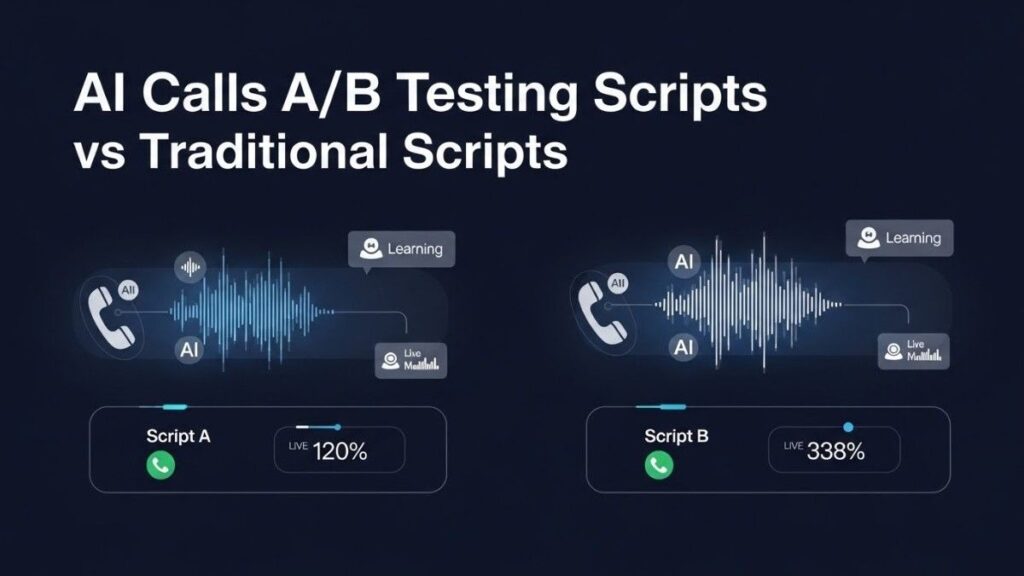
A/B testing scripts for AI calls involves creating multiple script versions and measuring which performs best. The AI system randomly assigns different scripts to different calls. Performance data reveals the winner objectively.
Version A might open with a question while Version B states a value proposition. The system tracks conversion rates, talk time, and sentiment for each approach. Superior performance becomes evident through data rather than opinion.
This scientific method eliminates guesswork from script optimization. You don’t need to wonder which approach works better. The numbers tell you definitively.
The testing happens automatically during regular business operations. No special test environments or artificial scenarios. Real conversations with actual prospects generate authentic results.
The Science Behind Script Testing
Statistical significance determines whether performance differences are real or random chance. The AI system calculates confidence levels automatically. You know when you have enough data to make decisions.
Sample size requirements vary based on expected effect size. Dramatic improvements need fewer test calls than subtle differences. The system continues testing until reaching statistical confidence.
Multivariate testing examines multiple variables simultaneously. You might test openings, value propositions, and closes in one experiment. This approach accelerates optimization across all script components.
Control groups ensure valid comparisons. Some calls use the existing script while others test new versions. This baseline comparison reveals actual improvement magnitude.
How AI Systems Enable Rapid Testing
Traditional phone teams can’t split test effectively. You’d need to divide representatives into groups. Ensure each group sticks to their assigned script. Track performance meticulously. The logistics become overwhelming quickly.
AI calling systems handle this complexity automatically. Each call receives a randomly selected script version. The system tracks every metric without human effort. Thousands of calls generate actionable insights within days.
Voice synthesis ensures consistent delivery across all calls. Human representatives vary tone, pacing, and emphasis unconsciously. These inconsistencies muddy test results. AI eliminates this variable completely.
Real-time performance monitoring lets you stop losing approaches immediately. If one script performs terribly, you can halt it mid-test. This prevents wasting opportunities on clearly inferior messaging.
Key Metrics for Evaluating Script Performance
Conversion rate represents the ultimate success metric. What percentage of calls achieve your objective? Booking meetings, closing sales, or getting commitments all count as conversions.
Average talk time reveals engagement levels. Longer conversations might indicate interest or confusion. Shorter calls could mean quick rejections or efficient qualification. Context determines interpretation.
Objection frequency shows which scripts trigger concerns. Perhaps one approach provokes pricing questions while another generates authority challenges. This insight guides refinement.
Sentiment analysis measures emotional responses. Does your script generate positive or negative feelings? Frustrated prospects rarely convert regardless of messaging quality.
Traditional Scripts vs AI-Enabled Testing
Traditional script development follows a waterfall model. Someone drafts a script. Management reviews and approves it. The team trains on it. Everyone uses it until someone decides to create a new version.
This approach offers zero feedback about actual effectiveness. You don’t know if alternative approaches would work better. The script becomes gospel without empirical validation.
A/B testing scripts for AI calls embraces continuous improvement. Every script version competes against alternatives. Winners replace losers automatically. Your messaging evolves toward maximum effectiveness.
Limitations of Traditional Script Development
Intuition-based scripting produces hit-or-miss results. Experienced salespeople share what works for them personally. Their specific style might not translate to others. Individual success doesn’t scale reliably.
Annual or quarterly script updates happen too infrequently. Market conditions shift faster than revision cycles. Your messaging lags behind reality by months.
Political factors influence script decisions more than data. The HIPPO (highest paid person’s opinion) often wins debates. Objective performance takes backseat to subjective preferences.
Testing traditional scripts requires elaborate frameworks. You need separate teams following different scripts. Tracking performance manually creates enormous overhead. Most organizations never attempt rigorous testing.
Advantages of AI-Powered Script Testing
Continuous optimization means your scripts improve constantly. Small gains compound over time into substantial performance improvements. You’re always using the best-known approach.
Objectivity replaces opinion in script decisions. Data shows definitively which approach converts better. Arguments about preferences become irrelevant.
Speed accelerates from months to days for testing cycles. You can validate new ideas rapidly. Failed experiments don’t waste months of team time.
Scale enables testing that human teams can’t match. Running ten script variations simultaneously is trivial for AI systems. Human teams struggle managing two versions.
Cost Implications and ROI
Traditional script development costs appear minimal. Someone drafts words in a document. No obvious expenses emerge beyond salary time.
Hidden costs lurk in opportunity costs. Every call using suboptimal scripts represents lost revenue. Multiply missed conversions by average deal value. The numbers become staggering quickly.
A/B testing scripts for AI calls requires platform investment. Software licensing and implementation carry real costs. The payback period typically measures in weeks rather than years.
Each percentage point improvement in conversion rate generates measurable revenue. A team making 1,000 calls weekly benefits enormously from small gains. Calculate your specific ROI based on volume and deal values.
Setting Up A/B Testing Scripts for AI Calls
Successful testing requires methodical setup. Random script changes generate random results. Strategic testing produces actionable insights.
Start with clear hypotheses about what might improve performance. Test one variable at a time initially. Learn which elements matter most before running complex multivariate experiments.
Establish baseline performance before testing variations. You need to know current conversion rates and metrics. This baseline enables measuring actual improvement.
Defining Test Objectives and Hypotheses
Specific goals guide effective testing. “Improve performance” lacks actionable direction. “Increase meeting bookings by 15%” provides clear targets.
Formulate hypotheses based on customer insights. Perhaps prospects complain about lengthy calls. You might hypothesize that shorter scripts convert better.
Prioritize tests by expected impact and ease of implementation. Some changes might deliver huge gains with minimal effort. Start there before tackling complex modifications.
Document your reasoning for each test. When results arrive, you’ll want to understand why certain approaches won. This learning accelerates future optimization.
Creating Script Variations
Test one element at a time in early experiments. Change the opening line or value proposition, not both simultaneously. Isolating variables reveals which changes drive results.
Make variations meaningful enough to detect differences. Tiny word changes probably won’t move metrics. Significant approach shifts generate clearer signals.
Maintain brand voice and compliance across all versions. Testing doesn’t excuse abandoning your company identity. Variations should feel like different expressions of the same brand.
Write multiple variations for each element. Don’t just test A versus B. Try A versus B, C, and D. More options increase chances of finding winners.
Selecting Appropriate Sample Sizes
Statistical power determines how many calls you need. Dramatic differences reveal themselves quickly. Subtle improvements require larger samples.
A/B testing scripts for AI calls calculators help determine required sample sizes. Input your expected improvement magnitude and desired confidence level. The tool tells you how many calls per variation.
Balance speed against confidence. Running tests longer increases certainty but delays implementation. Find the sweet spot for your decision-making style.
Consider segment sizes when testing. If you’re only testing scripts for enterprise prospects, you might get 50 calls weekly. Plan testing duration accordingly.
Implementing Tests in AI Call Systems
Configure your AI platform to randomly assign script versions. The randomization must be truly random to avoid bias. Most platforms handle this automatically.
Set up tracking for all relevant metrics. Conversion rates, talk time, objection types, and sentiment should all flow into your analytics. Comprehensive data enables deeper insights.
Establish monitoring procedures to catch problems early. Technical glitches might break randomization. One script version could fail completely. Regular checks prevent wasted test periods.
Create alerts for significant performance differences. If one script dramatically outperforms others, you want to know immediately. Early winners can replace entire test cohorts.
Best Practices for Script Testing
Following proven methodologies accelerates learning and prevents common pitfalls. A/B testing scripts for AI calls delivers maximum value when executed properly.
Patience matters despite the speed of AI testing. Run tests long enough to achieve statistical significance. Premature conclusions lead to poor decisions.
Documentation preserves institutional knowledge. Record what you tested, why, and what you learned. Future team members benefit from this history.
Testing One Variable at a Time
Isolated variable testing produces clear cause-and-effect understanding. You change the greeting and conversion improves. The greeting was the driver.
Simultaneous changes muddy attribution. Conversion improves but you don’t know which change caused it. Learning becomes impossible.
Sequential testing builds understanding systematically. Test openings first. Once you identify the winner, test different value propositions. Layer improvements methodically.
Multivariate testing comes after mastering single-variable experiments. Once you understand individual elements, testing combinations makes sense. Skip ahead and you’ll struggle interpreting results.
Ensuring Statistical Significance
Confidence intervals reveal whether differences are real. A 95% confidence level means you can trust the result. Lower confidence indicates more data is needed.
Avoid stopping tests prematurely because early results look good. Random variation can create misleading early patterns. Full sample sizes prevent false conclusions.
Calculate minimum detectable effect before starting. This determines the smallest improvement you care about detecting. Tests might not reveal tiny differences without massive sample sizes.
Use statistical tools built into testing platforms. Manual calculations introduce errors. Automated significance testing ensures reliable decisions.
Documenting and Analyzing Results
Record complete test details in a knowledge base. Script versions, metrics, sample sizes, and results all deserve documentation. This becomes your optimization playbook.
Look beyond simple win/loss declarations. Understand why winners performed better. Did they generate fewer objections? Create better engagement? The mechanism matters.
Segment analysis reveals whether winners work equally across groups. Perhaps one script wins with small businesses but loses with enterprises. This insight guides targeting.
Share learnings across teams. Sales, marketing, and product all benefit from understanding customer responses. Cross-functional sharing multiplies testing value.
Iterating Based on Insights
Winners become the new baseline for future tests. You’re not done optimizing. Test variations of winning scripts to find even better approaches.
Losing scripts provide valuable insights too. Understanding what doesn’t work prevents future mistakes. Document failures as thoroughly as successes.
Create hypothesis chains where one test informs the next. Perhaps shorter scripts won. Test even shorter versions. Push boundaries until you find optimal length.
Schedule regular testing cycles into your operations. A/B testing scripts for AI calls should be continuous, not occasional. Ongoing optimization compounds improvements.
Common Script Elements to Test
Every script component influences call outcomes. Systematic testing across all elements maximizes overall performance.
Start with high-impact elements that dramatically affect perception. Openings and closings shape first and last impressions. These often yield the biggest gains.
Don’t neglect seemingly minor details. The exact words you use for transitions matter. Cumulative small improvements add up to major advantages.
Opening Lines and Introductions
First impressions form within seconds. Your opening determines whether prospects engage or dismiss you. This makes openings prime testing territory.
Question-based openings might engage better than statements. “Are you struggling with X?” invites response. “I’m calling about X” allows easy dismissal.
Value-first openings establish relevance immediately. Lead with the benefit rather than your identity. Prospects care about solving problems, not who you are.
Personalization in openings shows you did research. Mentioning company-specific details demonstrates genuine interest. Generic approaches feel like spam calls.
Value Propositions and Key Messages
How you frame your offering dramatically impacts reception. Features versus benefits create different responses. Test multiple angles on your value.
Specific numbers often outperform vague claims. “Reduce costs by 30%” beats “significant savings.” Quantification adds credibility.
Customer story-based value propositions leverage social proof. “Companies like yours achieved X” resonates differently than “we help companies achieve X.”
Problem-focused versus solution-focused framing targets different mindsets. Some prospects respond to pain points. Others want to hear about possibilities.
Objection Handling Techniques
Common objections need scripted responses. Testing different approaches reveals which overcome resistance most effectively.
Acknowledge-and-redirect techniques validate concerns before offering alternatives. Dismissing objections defensively damages rapport. Empathetic responses maintain connection.
Question-based objection handling uncovers the real issue. “Not interested” might mask budget concerns or timing issues. Probing reveals true obstacles.
Story-based responses show how others overcame similar concerns. Social proof reduces perceived risk. Concrete examples beat abstract reassurance.
Call-to-Action Phrasing
Closing language determines whether calls end in commitments or polite dismissals. Direct requests perform differently than soft suggestions.
Specific versus open-ended CTAs create different pressure levels. “Can we schedule Thursday at 2pm?” differs from “when works for you?” Test both approaches.
Value reminders before CTAs reinforce why prospects should commit. Summarizing benefits right before asking creates urgency. The ask follows naturally from value.
Alternative choice closes give options while assuming agreement. “Would Tuesday or Thursday work better?” beats “would you like to schedule?” Both options advance the conversation.
Real-World Success Stories
Organizations across industries achieve remarkable improvements through A/B testing scripts for AI calls. These results demonstrate the practical power of continuous optimization.
The success stories span company sizes and sectors. Small startups compete against large competitors. Enterprise organizations finally achieve consistency across massive teams.
Learning from others accelerates your own testing programs. These examples reveal what’s possible.
SaaS Company Increases Meeting Bookings 47%
A software company used the same cold calling script for two years. Representatives booked meetings from 8% of calls. Leadership assumed this represented acceptable performance.
They implemented AI calling with script testing capabilities. The first test compared their traditional pitch-first opening against a problem-focused approach.
The problem-focused script achieved 11% booking rates. This 37.5% improvement emerged within one week of testing. The company immediately adopted the winner.
Subsequent tests optimized value propositions and closing language. After three months of continuous testing, booking rates reached 12%. The cumulative 50% improvement transformed their pipeline.
E-Commerce Brand Reduces Call Time While Improving Sales
An online retailer’s support team also handled order upgrades. Average call times were 8 minutes. Conversion rates on upgrades hovered around 15%.
Testing revealed that lengthy product explanations didn’t improve conversion. Shorter, benefit-focused scripts converted at 18% in just 5 minutes.
The company rolled out winning scripts across their team. Total call capacity increased 37.5% through time savings. Conversion improvements added further revenue.
Annual impact exceeded $2 million in additional sales. Call center costs dropped despite growing order volume. The ROI on testing exceeded 50:1 in the first year.
Financial Services Firm Optimizes Compliance While Improving Results
A wealth management firm needed scripts balancing regulatory requirements with engagement. Compliance mandated specific disclosures that prospects found tedious.
A/B testing scripts for AI calls helped find the optimal placement and phrasing for required statements. Front-loading disclosures lost 30% of prospects immediately.
Moving compliance language after establishing value retained 95% of listeners. The same information delivered later maintained compliance while improving engagement.
Conversion rates improved 25% through better disclosure timing. Compliance officers approved because scripts met all requirements. Sales and legal both won.
Healthcare Provider Improves Patient Appointment Scheduling
A medical practice struggled with appointment no-show rates near 25%. Their reminder call scripts used standard language unchanged for years.
Testing different reminder approaches revealed insights. Scripts emphasizing doctor preparation time reduced no-shows more than personal health focus.
“Dr. Smith is preparing for your appointment” outperformed “your health is important.” The preparation angle created social obligation. No-shows dropped to 12%.
Rescheduling language testing also proved valuable. Offering specific alternatives rather than open-ended questions doubled rescheduling rates. Patients committed to new times rather than canceling.
Measuring Long-Term Impact
Short-term test results tell only part of the story. A/B testing scripts for AI calls generates compounding benefits over time.
Track cumulative improvements to demonstrate overall program value. Single tests might show modest gains. The aggregate impact becomes transformative.
Calculate financial returns on testing investments. Revenue increases, cost reductions, and efficiency gains all contribute. Comprehensive ROI justifies continued optimization.
Tracking Conversion Rate Improvements
Establish baseline conversion rates before starting testing programs. This benchmark enables measuring total improvement over time.
Graph conversion rates across testing cycles. The upward trend visualizes optimization success. Share these visuals with stakeholders to maintain support.
Segment conversion tracking by customer type and call purpose. Different segments might show varying improvement rates. This insight guides testing focus.
Compare conversion rates against industry benchmarks. You want to know how your performance stacks up externally. Competitive context matters for strategic planning.
Analyzing Revenue Impact
Connect conversion improvements directly to revenue figures. Each additional conversion has a dollar value. Multiply improvement percentages by revenue per conversion.
Account for customer lifetime value, not just initial transaction value. Better scripts might attract higher-quality customers who spend more over time.
Calculate revenue per call as a comprehensive metric. This captures both conversion rate and deal size improvements. Single metric simplifies communication.
Project future revenue based on current improvement trajectories. If conversion rates grow 2% monthly, what does year-end look like? Forecasting maintains momentum.
Evaluating Customer Experience Improvements
Sentiment analysis reveals whether optimized scripts create better experiences. Higher conversion shouldn’t come at the expense of customer satisfaction.
Survey customers about their call experiences. Ask specifically about script elements. Their feedback validates or challenges your testing insights.
Track complaint rates and negative reviews mentioning calls. Increasing conversions while generating complaints isn’t sustainable. Balance metrics appropriately.
Monitor long-term retention rates for customers acquired through tested scripts. The quality of customers matters as much as quantity. Retention reveals true script effectiveness.
Calculating Return on Investment
Tally all costs associated with testing implementation. Software licensing, setup time, and ongoing management all count. Comprehensive cost accounting enables accurate ROI.
Compare costs against revenue gains attributable to testing. The ratio should be dramatically positive. Most organizations see 10:1 or better returns.
Include efficiency gains in ROI calculations. Shorter calls mean more capacity. Reduced training time has value. Quantify these benefits properly.
Present ROI figures regularly to maintain executive support. Testing programs compete for resources and attention. Clear value demonstration ensures continued investment.
Common Challenges and Solutions
Implementing A/B testing scripts for AI calls isn’t without obstacles. Organizations encounter predictable challenges. Anticipating these issues helps you navigate them successfully.
Technology limitations occasionally constrain testing sophistication. Workarounds exist for most limitations. Understanding boundaries helps set realistic expectations.
Organizational resistance slows adoption despite clear benefits. Change management matters as much as technical implementation.
Overcoming Sample Size Limitations
Small call volumes extend testing timelines. Achieving statistical significance takes longer. Patience becomes necessary.
Focus on testing larger effect sizes when samples are limited. Dramatic differences reveal themselves faster. Save subtle optimizations for when you have more volume.
Consider relaxing confidence requirements slightly. Moving from 95% to 90% confidence reduces required sample sizes. The tradeoff might be acceptable.
Extend tests across longer time periods to accumulate samples. A test requiring 1,000 calls might run several weeks. Plan accordingly when communicating timelines.
Managing Multiple Simultaneous Tests
Testing many elements simultaneously creates tracking complexity. You need systems preventing confusion about which test is which.
Implement clear naming conventions for tests and variants. “Opening_Test_3_Variant_A” beats “new_script_version_2.” Organization prevents mistakes.
Use project management tools to track active tests. Spreadsheets quickly become unwieldy. Dedicated testing platforms include built-in organization.
Limit simultaneous tests to what your team can manage. Three well-executed tests beat ten poorly managed ones. Quality over quantity.
Maintaining Compliance and Brand Voice
Regulatory requirements constrain script variations in regulated industries. Testing must occur within compliance boundaries.
Involve compliance teams in test design. They can approve variations before testing begins. This prevents discovering compliance issues after tests complete.
Create template structures that maintain required elements. Variable portions can change while mandatory disclosures remain consistent. Structure enables creativity within constraints.
Brand voice guidelines should govern all variations. Testing effectiveness doesn’t mean abandoning your identity. Voice consistency builds recognition and trust.
Dealing with Statistical Noise
Random variation sometimes creates false patterns in early results. One script might perform well purely by chance.
Run tests long enough to overcome statistical noise. Larger samples smooth out random fluctuations. Patience yields reliable conclusions.
Use appropriate statistical tests for your data type. Some metrics need different analysis approaches. Choose correctly to avoid misleading results.
Review results with skepticism about surprising findings. Dramatic improvements deserve scrutiny. Verify that measurements are accurate before celebrating.
The Future of AI Call Script Testing
Voice AI technology advances rapidly. Today’s capabilities will seem primitive within a few years. Understanding trends helps you plan strategically.
A/B testing scripts for AI calls will become more sophisticated and accessible. Current enterprise-only features will reach small businesses. Democratization levels competitive playing fields.
Integration with other AI systems will create comprehensive optimization. Scripts, timing, targeting, and follow-up will optimize holistically.
Real-Time Script Adaptation
Future systems will adjust scripts during calls based on prospect responses. The AI detects signals and shifts approaches dynamically. Static scripts evolve into fluid conversations.
Emotional intelligence will guide real-time adjustments. Frustration triggers empathy language. Enthusiasm gets matched with excitement. Tone adapts to emotional state.
Personalization will extend beyond names to incorporate known preferences. The system might reference past interactions or researched information. Each call feels uniquely tailored.
Industry and company-specific customization will happen automatically. The AI researches prospects before calling. Scripts incorporate relevant details without manual preparation.
Predictive Script Optimization
Machine learning will predict optimal scripts before testing. The AI analyzes patterns across thousands of previous tests. It suggests variations likely to succeed.
Automated hypothesis generation will accelerate testing cycles. The system identifies underperforming script elements and proposes improvements. Human oversight guides but doesn’t limit exploration.
Cross-company learning will improve predictions. Anonymized performance data across client bases reveals universal principles. Your testing benefits from others’ learnings.
Seasonal and trend-based optimization will adjust scripts proactively. The AI recognizes that holiday periods need different approaches. Scripts evolve with market conditions automatically.
Integration with Broader AI Ecosystems
Voice testing will connect with email, chat, and other channel optimizations. Consistent messaging across touchpoints will improve holistically. Omnichannel testing becomes standard.
CRM integration will enable closed-loop attribution. The system tracks which scripts generate customers who stick around. Long-term value informs script optimization.
Predictive analytics will identify which prospects need which scripts. The AI assigns script versions based on likelihood to respond. Targeting and messaging optimize together.
Autonomous optimization will reduce human involvement. The system runs tests, analyzes results, and implements winners automatically. Humans set goals while AI handles execution.
Frequently Asked Questions
What is A/B testing scripts for AI calls?
A/B testing scripts for AI calls means creating multiple script versions and letting AI systems randomly assign them to calls. The technology tracks performance metrics for each version. Data reveals which scripts convert best. You optimize continuously based on real results.
How is this different from traditional call scripting?
Traditional scripting uses one script until leadership decides to change it. Testing rarely happens. AI-enabled testing compares multiple approaches simultaneously. You optimize based on data rather than intuition.
How long does it take to see results?
Simple tests can show statistical significance within days. Complex tests might require several weeks. The timeline depends on call volume and expected effect size.
Can small businesses use this technology?
Modern AI calling platforms offer entry-level pricing. Small businesses access the same testing capabilities as enterprises. The main requirement is sufficient call volume for meaningful testing.
What metrics should we track?
Conversion rate matters most. Track whatever action you want callers to take. Also monitor talk time, objection rates, and sentiment scores for comprehensive insights.
How many script variations should we test?
Start with two or three variations for simple elements. Test more variations once you master the basics. Balance learning speed against management complexity.
Do we need technical expertise to run tests?
Most modern platforms offer user-friendly interfaces. Marketing and sales teams can configure tests without engineering help. Setup takes minutes, not weeks.
How much does testing typically improve performance?
Results vary by starting point and testing sophistication. Most organizations see 15-50% conversion improvements within six months. Continuous testing compounds gains over time.
Taking Action on Script Testing
Understanding A/B testing scripts for AI calls creates opportunity. Knowledge without action changes nothing. Your next steps determine whether insights transform results.
Start by auditing your current call scripts. When did you last update them? What evidence supports their effectiveness? Honest assessment reveals improvement opportunities.
Define specific goals for testing programs. Increase conversion by a certain percentage. Reduce call time while maintaining quality. Clear objectives guide effective testing.
Research AI calling platforms with built-in testing capabilities. Request demos focused on your use cases. Evaluate how well systems handle your specific requirements.
Begin with small pilot tests targeting high-volume call types. Prove value before expanding. Success builds momentum and secures continued investment.
Remember that testing is continuous, not a one-time project. Plan for ongoing optimization. The best scripts today will be second-best tomorrow.
Read More:-From Chatbots to Voice AI: A UX Design Framework
Conclusion
Call script quality determines success in phone-based sales and support. Every word influences outcomes. Traditional approaches leave performance to chance.
A/B testing scripts for AI calls transforms scripting from art into science. You test variations systematically. Data reveals what actually works. Scripts improve continuously.
The methodology eliminates guesswork and politics from script decisions. Numbers show definitively which approaches convert better. Arguments about preferences become irrelevant.
Implementation requires commitment beyond just technology adoption. You need testing discipline and result analysis. Teams must embrace continuous improvement culture.
Organizations making this shift gain substantial competitive advantages. They convert more prospects with existing resources. Efficiency improves while effectiveness increases simultaneously.
The testing capabilities will only become more sophisticated. Early adopters build expertise and institutional knowledge. They develop optimization capabilities competitors struggle to match.
Your current scripts likely underperform. Competitors already testing scripts pull ahead steadily. The gap widens with each improvement cycle they complete.
Start your testing initiative today. Audit existing scripts. Define improvement goals. Explore platforms enabling systematic optimization. Take the first step toward scientifically optimized call scripts. The performance improvements you gain will transform your results.