
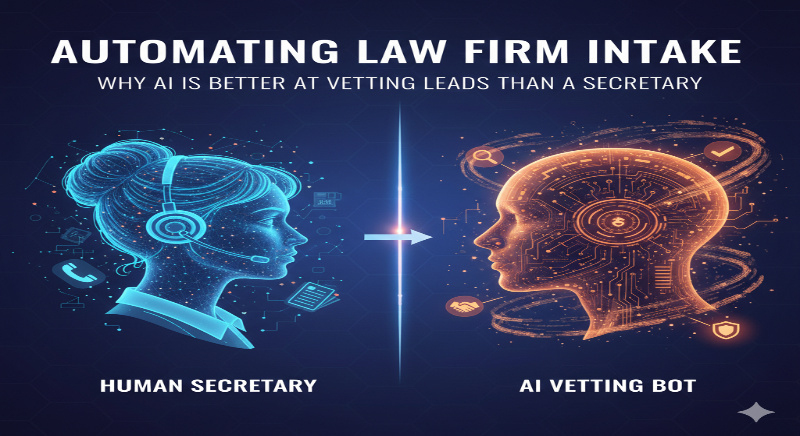
Automating Law Firm Intake: Why AI Is Better at Vetting Leads Than a Secretary
Introduction
Table of Contents
TL;DR Every law firm has the same problem. A potential client calls. No one picks up. The client moves on to the next firm.
This is the cost of relying on a human secretary for lead intake.
Automating law firm intake changes this completely. It captures leads at any hour,asks the right questions, scores and routes each prospect without delay.
AI does not sleep. It does not miss calls on Friday afternoons. It never forgets to follow up.
This blog walks you through why AI outperforms a secretary in every key area of client intake. You will also learn how to build a smarter intake system for your firm today.
What Is Law Firm Intake and Why Does It Matter?
Law firm intake is the process of receiving, qualifying, and onboarding a new client. It starts the moment a prospect contacts your firm. It ends when you accept or decline the case.
This process sounds simple. In reality, it breaks down constantly.
Calls go to voicemail. Intake forms sit unanswered for hours. Receptionists ask inconsistent questions. Some leads get followed up quickly. Others fall through completely.
Every missed lead is lost revenue. Every slow response damages your firm’s reputation.
A weak intake system costs law firms thousands of dollars each month. Automating law firm intake eliminates these costly gaps. It creates a consistent, fast, and repeatable experience for every lead.
The Real Limits of a Human Secretary in Legal Intake
Availability Is Always a Problem
A secretary works set hours. Most potential clients call outside those hours. Studies show that 60% of legal calls go to voicemail after 5 PM.
A missed call often means a lost case. Clients in legal distress do not wait. They call the next firm on the list.
AI intake software answers every call. It works around the clock, every single day of the year.
Human Error Creates Inconsistency
A secretary might ask different questions on Monday versus Friday. Mood, fatigue, and interruptions all affect quality.
One receptionist may ask the right qualifying questions. Another might skip half of them.
This inconsistency means your firm lacks accurate data. You cannot reliably compare leads or track conversion rates.
Automating law firm intake removes human variability. Every lead gets the same structured process every time.
Secretaries Cannot Handle High Volume
A human can manage one call at a time. During busy periods, calls pile up.
Hold times increase. Frustration grows. Leads abandon the call entirely.
An AI intake system handles unlimited simultaneous inquiries. It never puts a caller on hold. It scales instantly during your busiest hours.
How AI Transforms the Intake Process for Law Firms
Instant Lead Capture Across Every Channel
People contact law firms through many channels. Phone calls. Website forms. Live chat. Text messages. Email.
A secretary can only manage one channel at a time. AI covers all of them at once.
When someone fills out a contact form at 2 AM, AI responds within seconds. It starts the qualification conversation immediately.
This speed matters. Research shows that responding to a lead within five minutes increases conversion rates by up to 400%.
Automating law firm intake makes that five-minute response a reality for every lead, every time.
Smart Qualification Questions That Never Get Skipped
Not every caller is a good fit for your firm. AI intake tools use logic-based question flows to qualify each lead properly.
The system asks about case type, incident date, location, and budget. It identifies whether the lead matches your firm’s practice areas.
If someone calls about a criminal matter and your firm handles only personal injury, AI routes them elsewhere immediately. No time wasted.
This intelligent filtering is core to automating law firm intake effectively. Your attorneys spend time only on viable cases.
Lead Scoring That Prioritizes the Best Cases
AI does not treat all leads equally. It scores each prospect based on set criteria.
High-value cases get immediate attention. Lower-priority leads get added to a nurture sequence. Unqualified leads are politely declined.
This scoring system gives your firm a competitive edge. You focus your energy on cases with the highest potential value.
A secretary cannot do this analysis on the fly. Automating law firm intake makes smart prioritization automatic.
Automated Follow-Up Sequences
Most leads do not convert on the first contact. They need multiple touchpoints before making a decision.
AI intake systems send automated follow-up emails and text messages. They remind leads to schedule consultations., answer common questions, send reminders before appointments.
These follow-up sequences run without any manual effort. Your team does not need to track who has been contacted.
Every lead stays warm until they convert or opt out.
Key Features to Look for in AI Intake Software
24/7 Availability and Multichannel Coverage
Your intake tool must work at all hours. It needs to capture leads from your website, phone line, and chat widget.
Look for software that integrates with your existing communication channels. Seamless integration reduces setup time and errors.
CRM Integration for Seamless Lead Management
AI intake works best when connected to your legal CRM. Every new lead should populate your database automatically.
The system should create a contact record, log conversation details, and set follow-up tasks without any manual data entry.
Automating law firm intake at this level saves hours of administrative work each week.
Customizable Intake Workflows
Every firm is different. Your intake questions should reflect your practice areas and client standards.
Good AI intake tools let you customize the question flow. You can set rules for routing, escalation, and follow-up timing.
This flexibility ensures the system works for your specific firm, not a generic template.
Compliance and Data Security
Legal intake involves sensitive client information. Your AI system must meet data privacy standards.
Look for tools with end-to-end encryption, secure data storage, and clear privacy policies. Confirm the software complies with applicable bar association rules in your jurisdiction.
Analytics and Reporting
You cannot improve what you do not measure. Your intake system should track lead source, qualification rate, conversion rate, and response time.
This data helps you identify where leads drop off. It shows you which channels bring in the best cases. It informs smarter marketing decisions.
AI vs. Secretary: A Direct Comparison
Here is a clear look at how the two options compare across the most important intake criteria.
Response Speed: A human secretary takes minutes to answer and may miss calls entirely. AI responds within seconds, every time.
Availability: A secretary works business hours only. AI works 24 hours a day, 7 days a week, 365 days a year.
Consistency: A human brings variability based on mood and skill level. AI delivers the same structured intake process every single time.
Scalability: One secretary handles one call at a time. AI handles unlimited simultaneous interactions.
Lead Scoring: A secretary lacks tools to score leads objectively. AI uses preset criteria to rank and prioritize each prospect.
Cost: A full-time secretary carries a salary, benefits, and training costs. AI software has a flat monthly subscription fee.
Automating law firm intake across all these areas creates a massive operational advantage. The comparison is not even close.
Real Costs of Not Automating Your Law Firm Intake
Some firms still hesitate to adopt AI intake. The reasoning is usually about preserving the human touch.
That reasoning is expensive.
A firm that misses ten leads per month at an average case value of $5,000 loses $50,000 in potential revenue. Every single month.
That is $600,000 per year walking out the door because no one answered the phone.
Beyond revenue, slow intake damages your reputation. Clients talk. Reviews spread. A firm known for slow responses struggles to compete.
Automating law firm intake protects your revenue. It builds a reputation for responsiveness. It gives you a competitive edge in a crowded market.
How to Implement AI Intake in Your Law Firm
Audit Your Current Intake Process
Start by mapping out how leads currently enter your firm. Identify every touchpoint. Find the gaps and delays.
Ask yourself how long it takes to respond to a new lead. Calculate how many leads go unanswered each week.
This audit gives you a baseline. You will use it to measure improvement after implementing AI.
Define Your Ideal Client Profile
AI intake only works well if it knows who to qualify. Define your ideal client clearly.
What case types do you accept? geographic areas do you serve?
These criteria go directly into your AI intake workflow. The system uses them to score and sort every lead.
Choose the Right Software
Several platforms specialize in automating law firm intake. Look for tools built specifically for legal practices.
Popular options include Clio Grow, Lawmatics, and Lexicata. Each offers CRM integration, automated follow-up, and customizable intake forms.
Evaluate pricing, integrations, and support before committing. Request a demo from your top two or three choices.
Build and Test Your Intake Workflow
Set up your question flow, routing rules, and follow-up sequences. Test every scenario before going live.
Run test leads through the system. Check that notifications, routing, and data capture work correctly.
Fix any issues before clients interact with the system.
Train Your Team
AI handles intake, but your attorneys still close cases. Train your team to use the CRM data generated by the system.
They should know how to review lead scores, read conversation transcripts, and prioritize follow-up actions.
The technology only creates value when your team uses it correctly.
Monitor and Optimize
Review your intake analytics monthly. Look at response times, qualification rates, and conversion rates.
Refine your question flows based on where leads drop off. Adjust your follow-up timing if response rates are low.
Automating law firm intake is not a one-time setup. It is an ongoing optimization process.
Secondary Considerations: Practice Area Customization
Personal Injury Intake Automation
Personal injury firms deal with high call volume and time-sensitive cases. AI intake can ask about accident date, injury severity, and insurance details immediately.
Cases with recent injuries and strong liability facts get scored highest. These receive instant follow-up.
Family Law Intake Automation
Family law cases are emotionally charged. AI intake tools can handle initial triage while maintaining a warm, empathetic tone.
The system collects details on case type, custody concerns, and urgency. It routes urgent situations to available attorneys quickly.
Criminal Defense Intake Automation
Criminal defense clients need fast responses. An arrest requires immediate legal help.
AI intake can identify the charge type, jurisdiction, and court date. It escalates urgent criminal matters to on-call attorneys right away.
Estate Planning Intake Automation
Estate planning leads are less urgent but high in lifetime value. AI intake collects asset information and scheduling preferences.
Automated follow-up sequences keep these leads engaged until they book a consultation.
Frequently Asked Questions About Automating Law Firm Intake
Is AI intake compliant with bar association rules?
Most AI intake tools are designed with legal compliance in mind. They do not provide legal advice. They only collect and route information.
Always review your jurisdiction’s rules on client communication and data privacy. Confirm your chosen software meets those standards before deployment.
Will clients feel uncomfortable talking to AI?
Modern AI intake tools communicate naturally and professionally. Many clients cannot tell they are interacting with an automated system.
More importantly, clients respond positively to fast responses. Getting an answer in 30 seconds beats waiting on hold for 10 minutes.
How much does AI intake software cost?
Pricing varies widely. Basic tools start at around $100 per month. Advanced platforms with full CRM integration range from $300 to $800 per month.
Compare this against the cost of one missed case. The return on investment is almost always significant.
Can AI intake replace my receptionist entirely?
AI handles the initial intake and qualification process. Your team still manages consultations, negotiations, and client relationships.
Many firms use AI intake to allow their receptionists to focus on higher-value work rather than eliminating the role entirely.
How long does it take to set up an AI intake system?
Most platforms offer onboarding within one to two weeks. Setup involves building your intake questionnaire, connecting your CRM, and testing your workflow.
Some vendors provide white-glove setup services. This shortens the implementation timeline significantly.
What happens to leads that do not qualify?
Non-qualifying leads should not be ignored. They often refer others or return with different matters later.
Good AI intake tools send non-qualifying leads a polite decline message. Some include referral resources or general legal information.
This professional handling protects your firm’s reputation even with leads you cannot take.
Data and Statistics Supporting AI-Driven Legal Intake
The numbers behind automating law firm intake are compelling. They show a clear business case for adoption.
Law firms that use automated intake report a 30% to 50% increase in qualified lead conversion rates. Faster response times are the primary driver.
Over 70% of legal consumers say they choose a firm based on responsiveness. Speed of response matters more than any other single factor.
Firms using AI intake reduce administrative costs by an average of 20 to 40 hours per month. That time shifts to billable work.
Client satisfaction scores improve significantly when intake is fast and consistent. Happy clients leave better reviews and refer more cases.
These numbers confirm that automating law firm intake is not just a convenience. It is a strategic business advantage.
Common Mistakes to Avoid When Automating Legal Intake
Over-Automating the Process
AI handles intake well. It does not replace human judgment in case evaluation.
Do not remove attorneys from the final qualification step. Use AI to gather information and let your team make the final decision on whether to accept a case.
Ignoring Mobile Optimization
Most legal leads come from mobile devices. Your intake forms and chatbots must work perfectly on smartphones.
Test every form and chat interface on multiple mobile browsers before going live.
Setting and Forgetting the System
AI intake needs regular review and optimization. Question flows become outdated. Follow-up sequences lose effectiveness.
Schedule monthly reviews of your intake analytics. Make adjustments based on real performance data.
Skipping the Human Handoff
AI should hand qualified leads to a human promptly. Do not let a strong lead sit in a queue for hours after qualification.
Set up real-time notifications for your team when high-scoring leads come in. Speed still matters after the AI has done its job.
Read More:-The “Turing Test” for Sales: Can Your Customers Tell Your Bot is AI?
Conclusion

The legal market is competitive. Clients have options. They choose firms that respond fast, communicate clearly, and show professionalism from the very first contact.
A human secretary cannot deliver that experience consistently. Schedules, fatigue, and limited bandwidth hold them back.
Automating law firm intake removes those limitations. AI captures every lead. It qualifies each prospect with precision,follows up without fail,scores and routes cases so your attorneys see only the best opportunities.
The firms winning more cases today are not necessarily the most skilled. They are the most responsive.
Start the process of automating law firm intake now. Audit your current system. Define your ideal client. Choose the right software. Build a workflow that runs 24/7.
Your competition is already moving in this direction. Every day you delay is a day your best leads go somewhere else.
Automating law firm intake is not the future of legal practice. It is the present. Get ahead of it today.