
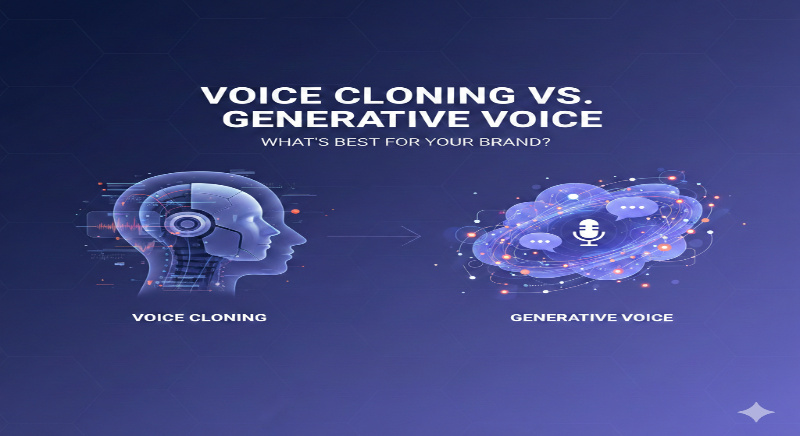
Voice Cloning vs. Generative Voice: What’s Best for Your Brand?
Introduction
Table of Contents
TL;DR Your brand’s voice is more than a tagline.It is the sound of your identity. It is how customers feel your brand before they see it.AI audio technology now gives brands two powerful choices. You can clone a real human voice. You can generate a completely synthetic voice from scratch.
Both options sound impressive. Both serve very different purposes.
The voice cloning vs generative voice decision is one of the most important audio choices a brand will make. Choose wrong and you waste time, money, and brand equity.
This guide explains each technology in depth. It covers costs, use cases, limitations, and the exact scenarios where each approach wins.
By the end, you will know exactly which path fits your brand and your goals.
What Is Voice Cloning?
Voice cloning creates a digital replica of a specific human voice.
The process uses recordings of a real person speaking. An AI model analyzes pitch, tone, rhythm, cadence, and accent from those recordings. The system learns to reproduce that voice with high fidelity.
Early voice cloning required hours of audio data. Modern tools work with as little as three minutes of clean recording.
The output is a synthetic version of the source voice. It can read any text script and sound like the original speaker said it.
Voice cloning works best when a brand wants to preserve a specific, recognizable voice identity. It keeps the unique characteristics of a real person intact.
Brands use voice cloning for CEO narration, brand ambassador audio, character voice preservation, and spokesperson continuity.
When you hear a celebrity voice in an ad that was clearly not recorded specifically for that product, cloning technology often powers it.
The voice cloning vs generative voice discussion starts here. Cloning is fundamentally about replication. It copies something that already exists.
That distinction matters enormously for branding strategy. You must have a source voice to clone. The quality of the clone depends entirely on the quality of the original recordings.
Legal consent from the source speaker is non-negotiable. Major platforms and most jurisdictions now require explicit written consent for commercial voice cloning.
Voice cloning produces the most natural-sounding results when the source is a skilled, trained speaker. Amateur recordings produce noticeably lower quality clones.
What Is Generative Voice?
Generative voice creates completely new synthetic voices that never existed as real humans.
AI models train on massive datasets of human speech. They learn the patterns, properties, and qualities that make voices sound natural.
The system then constructs novel voices by combining and interpolating learned characteristics. No source speaker exists. No recordings get copied.
The output is a unique voice with controllable traits. Developers specify accent, pitch, warmth, pace, energy level, and gender presentation.
Generative voice gives brands total design freedom. You can build a voice that fits your brand personality precisely without being limited by any real person.
Platforms like ElevenLabs, Murf, and Play.ht offer libraries of pre-built generative voices. They also allow custom voice design from scratch.
In the voice cloning vs generative voice debate, generative technology wins on flexibility and accessibility. No consent issues,source recordings needed. and dependency on a specific person.
Generative voices improve continuously as underlying models improve. A voice your brand created in 2023 sounds better today because the engine powering it has been updated.
Major brands use generative voices for IVR phone systems, product tutorials, e-learning content, video narration, and AI customer service agents.
The voice does not belong to any person. The brand owns it entirely.
This ownership dimension is a major competitive advantage. Your competitor cannot use your generative brand voice. It is proprietary by design.
Voice Cloning vs Generative Voice: Core Technical Differences
Input Requirements
Voice cloning requires a real human speaker and recorded audio samples.
The quality and quantity of input recordings directly determine the quality of the clone.
Professional recording conditions matter. Background noise, compression artifacts, and inconsistent microphone placement all degrade clone fidelity.
Generative voice requires no input recordings. The brand defines parameters and the system generates the voice from AI models.
This makes generative voice far more accessible to teams without dedicated recording infrastructure.
Naturalness and Emotional Range
Voice cloning produces voices that feel deeply human. A good clone captures subtle vocal quirks that make a voice recognizable and trustworthy.
Cloned voices carry the emotional range of the original speaker. Warmth, humor, authority, and energy all transfer if the source recordings contain them.
Generative voices have improved dramatically. Top-tier platforms now produce voices nearly indistinguishable from real humans.
Some emotional subtlety still favors cloning. The micro-expressions of authentic human speech are hard to replicate purely synthetically.
Scalability and Production Speed
Generative voice scales without limit. You need more content in a different language? The system generates it instantly.
Voice cloning can also scale content production. Once a voice is cloned, it generates unlimited audio from text.
The voice cloning vs generative voice difference on scalability relates to language flexibility. Cloned voices often struggle with languages the original speaker does not know.
Generative voices handle multilingual content natively. The same brand voice speaks fluent Spanish, French, and Mandarin without any source speaker requirement.
Legal and Ethical Considerations
Voice cloning carries significant legal obligations. The source speaker must provide informed written consent for commercial use.
Using a cloned voice for content the speaker would find objectionable creates serious legal and reputational risk.
Generative voices carry no consent obligations to any real person. The brand owns the voice outright.
Disclosure requirements vary by jurisdiction. Some markets require labeling AI-generated audio. Understand your legal obligations before publishing either voice type commercially.
Brand Identity: How Each Technology Shapes Your Voice
Building Authenticity with Voice Cloning
Authenticity is the most powerful argument for voice cloning.
A cloned CEO voice on company communications builds credibility. Customers hear the actual person leading the business.
A brand ambassador with a distinctive voice carries recognition across years of campaigns. Cloning preserves that voice for scaling content production.
Authenticity drives trust. Trust drives purchase decisions.
Brands with strong founder or spokesperson voices invest in cloning to protect and scale that authentic connection.
The voice cloning vs generative voice question, from an authenticity angle, almost always favors cloning when a recognizable real voice already exists and carries strong brand equity.
Building Distinctiveness with Generative Voice
Generative voice wins on distinctiveness and intentional brand design.
You design the voice the same way you design a logo. Every sonic characteristic serves a strategic purpose.
A fintech brand might design a calm, measured voice that communicates stability. A gaming brand might create an energetic, edgy voice that resonates with younger audiences.
Generative voice gives complete creative and commercial control.
This design-first approach to brand audio is increasingly popular among companies building AI-powered customer experiences.
Consistency Across Touchpoints
Brand voice consistency matters enormously.
Customers hear your brand voice in product tutorials, customer service lines, marketing content, and in-app experiences.
Both voice cloning and generative voice deliver consistency. Every piece of audio content uses the exact same voice.
Cloning maintains consistency with the human source. Any shift in the real person’s voice over time requires re-cloning.
Generative voice stays perfectly consistent forever. The designed voice never ages, gets sick, or changes due to life circumstances.
For long-term brand consistency, generative voice carries a structural advantage.
Use Cases Where Voice Cloning Wins
Founder and Executive Communications
Some brands are built on a founder’s personal voice.
Warren Buffett narrating Berkshire Hathaway investor content. A startup CEO explaining the company vision. A renowned chef narrating cooking instruction videos.
These voices carry irreplaceable authority. Cloning them allows scale without sacrificing authenticity.
Voice cloning vs generative voice in this context is not a close call. Cloning wins completely when the source voice carries personal brand power.
Audiobook and Content Narration
Authors who narrate their own books build deep connections with readers.
Voice cloning allows authors to narrate companion content, foreign language editions, and future titles without repeating full recording sessions.
Publishers use author voice clones to produce supplementary content efficiently.
The listener experience stays consistent with the original recording the audience fell in love with.
Character Voice Preservation in Entertainment
Film studios, game developers, and animation companies work with voice actors for years.
When a key voice actor retires or passes away, continuity suffers.
Voice cloning preserves beloved character voices for future installments.
This application requires careful ethical handling and explicit consent. Some estates approve commercial cloning. Others do not.
Personalized Customer Experiences
Some high-end customer experience applications personalize voice interactions with a real company spokesperson.
A financial advisor’s cloned voice narrates personalized client portfolio updates. A doctor’s cloned voice delivers personalized patient care instructions.
The personal relationship extends beyond the in-person interaction into automated communications.
This creates genuine emotional resonance that generic synthetic voices cannot match.
Use Cases Where Generative Voice Wins
AI Customer Service and IVR Systems
Call center AI and IVR phone systems serve millions of interactions daily.
A generative brand voice handles every call with perfect consistency. No source speaker works shifts. No person gets tired.
The brand voice carries through the entire customer service experience.
Voice cloning vs generative voice for customer service almost always favors generative. Scale, cost, and consistency all point the same direction.
Global Multilingual Content
Brands operating across multiple markets face a fundamental challenge with voice cloning.
A cloned English-speaking voice sounds unnatural reading French or Japanese text.
Generative voice builds multilingual voices natively. The brand voice speaks every language with authentic pronunciation and natural cadence.
Global content teams save enormous production time with a generative multilingual voice strategy.
E-Learning and Training Content
Corporate training, online courses, and product education require enormous volumes of audio content.
Content updates constantly. New regulations, product changes, and policy revisions require frequent re-recording.
E-learning producers report 60 to 80 percent reductions in audio production time after switching to generative voice.
Scalable Marketing and Advertising Content
A/B testing ad copy requires multiple audio versions of the same script.
Generative voice produces unlimited variations instantly. Brands test different tones, paces, and vocal energy levels to find what converts best.
Real voice talent recording multiple versions costs thousands of dollars per round of testing.
Generative voice makes continuous audio optimization economically viable for brands of every size.
Cost Comparison: Voice Cloning vs Generative Voice
Cost is a decisive factor for most brands choosing between these two technologies.
Voice cloning upfront costs are higher. Professional recording sessions for quality source audio cost $500 to $5,000. The cloning service itself ranges from $300 to several thousand dollars depending on quality and platform.
Enterprise-grade cloning with biometric accuracy and legal protections can cost $10,000 or more for the initial build.
Ongoing usage after the clone is built can be cost-efficient. Many platforms charge per character or per minute of generated audio.
Generative voice carries lower entry costs. Most platforms offer subscription models starting from $25 to $300 per month for commercial use.
Custom voice design services from major providers range from $500 to $3,000 for a bespoke brand voice.
The voice cloning vs generative voice cost calculation also includes hidden factors.
Voice cloning requires ongoing consent management, re-cloning as voices change, and potential legal costs.
Generative voice requires no talent fees, no re-recording sessions, and no consent compliance overhead.
For most small to mid-sized brands, generative voice delivers better cost efficiency over a three to five year horizon.
Larger brands with established spokesperson relationships may find cloning more cost-effective when they already have quality source recordings.
Ethical and Legal Landscape for Both Technologies
Consent Requirements for Voice Cloning
Voice cloning without consent is illegal in many jurisdictions.
The United States, European Union, and several other markets now require explicit written consent from the source speaker for commercial voice cloning.
Consent must cover the specific commercial applications. A consent form for podcast narration does not cover advertising use.
Always engage a legal professional before deploying cloned voices commercially. The consent framework must hold up to scrutiny.
Deepfake Risks and Reputation Management
Voice cloning creates genuine deepfake risk.
A misused cloned voice can put words in a real person’s mouth. Malicious actors can fabricate statements that damage the source speaker’s reputation.
Brands using voice cloning must implement security controls. Access to the cloned voice model stays restricted. Usage logs track every generated audio file.
The voice cloning vs generative voice risk profile differs significantly here. Generative voices carry no deepfake risk for real individuals.
FTC and Disclosure Guidelines
Regulators around the world now demand disclosure when AI voices appear in consumer-facing content.
The Federal Trade Commission in the US requires clear disclosure of AI-generated audio in advertising contexts.
Many platforms that publish AI audio content now require disclosure metadata or on-screen labels.
Brands should implement disclosure practices now. Voluntary compliance today prevents mandated compliance penalties tomorrow.
How to Choose the Right Approach for Your Brand
The voice cloning vs generative voice decision comes down to five key questions.
First, does your brand already have a distinctive human voice with strong recognition? If yes, cloning preserves and scales that asset.
Second, does your brand need multilingual content at scale? If yes, generative voice handles global markets far more efficiently.
Third, do you have legal consent and high-quality recordings from your desired source speaker? If no, cloning creates legal and quality obstacles.
Fourth, does your brand need total long-term control over the voice asset? If yes, generative voice provides permanent ownership without external dependencies.
Fifth, does your use case require deep emotional authenticity that only a real person can provide? If yes, cloning delivers results generative voice cannot fully match.
Most brands building AI-powered customer experiences choose generative voice. The scalability, ownership, and cost advantages are compelling.
Brands with established spokesperson voices and existing audience relationships often choose cloning to preserve proven brand equity.
Some sophisticated brands deploy both strategies. A generative voice handles customer service and routine content. A cloned executive voice handles key communications and brand-defining moments.
This hybrid approach extracts maximum value from each technology.
Frequently Asked Questions: Voice Cloning vs Generative Voice
What is the main difference between voice cloning and generative voice?
Voice cloning replicates a specific existing human voice. Generative voice creates an entirely new synthetic voice from AI training data.
Cloning requires a real source speaker and audio recordings. Generative voice requires only design parameters and a platform.
The voice cloning vs generative voice difference is fundamentally about replication versus creation.
Which sounds more natural to listeners?
High-quality voice cloning typically sounds more naturally human because it preserves the subtle imperfections and vocal qualities of a real person.
Top-tier generative voice platforms have narrowed the gap dramatically. Many listeners cannot distinguish between premium generative voices and real humans.
The naturalness advantage of cloning diminishes as generative AI continues to improve.
Is voice cloning legal?
Voice cloning is legal when you have explicit written consent from the source speaker for the specific commercial applications you intend.
Cloning without consent violates intellectual property rights and privacy laws in most major jurisdictions.
Always consult a legal professional before commercializing any cloned voice. Requirements vary by country and use case.
Can I use a generative voice internationally?
Yes. This is one of the strongest advantages in the voice cloning vs generative voice comparison.
Generative voices generate multilingual audio natively. Your brand voice speaks every language without needing a native-speaking source actor for each market.
How long does it take to create a cloned voice?
Modern voice cloning platforms deliver results in 24 to 72 hours for standard quality.
Enterprise-grade cloning with advanced accuracy testing takes one to two weeks including recording session coordination.
Generative voice creation is faster. Custom voice design from a brief can deliver usable results in 48 hours.
Which is better for an AI customer service bot?
Generative voice fits AI customer service far better for most brands.
Customer service requires scale, consistency, and multilingual capability. Generative voice delivers all three without the consent management complexity of cloning.
The voice cloning vs generative voice verdict for AI customer service is clear. Generative wins on practicality and cost.
Can I switch from one approach to the other later?
Yes. Many brands start with a generative voice for speed and accessibility. They later commission a custom clone as their brand spokesperson identity matures.
Some brands run both simultaneously for different use cases.
The technologies are complementary. They do not require exclusive commitment.
Secondary Keywords and Related Concepts to Know
The voice cloning vs generative voice topic sits within a broader ecosystem of AI audio technology.
Text-to-speech technology is the parent category for both approaches. It converts written text into spoken audio using AI models.
Synthetic voice refers to any AI-generated audio output, including both cloned and generative voices.
AI voice generation describes the technical process of creating audio from text using neural network models.
Custom voice AI refers to brand-specific voice assets built on either cloning or generative platforms.
Neural text-to-speech is the specific branch of AI that powers high-quality modern voice generation. It produces far more natural output than older rule-based TTS systems.
Voice user interface or VUI describes the design discipline of creating experiences where voice is the primary interaction channel. Both cloned and generative voices power VUI applications.
Sonic branding is the strategic practice of using sound, including voice, as a brand identity element. The choice between voice cloning vs generative voice is a core sonic branding decision.
Understanding these related terms helps brands communicate effectively with audio technology vendors and make informed platform decisions.
Direct Comparison: Voice Cloning vs Generative Voice at a Glance
Source Requirement: Voice cloning needs real human recordings. Generative voice needs design parameters only.
Setup Cost: Voice cloning runs $500 to $10,000 or more upfront. Generative voice starts from $25 per month on subscription platforms.
Naturalness: Voice cloning produces the most human-sounding results today. Generative voice closes the gap rapidly with each model update.
Legal Complexity: Voice cloning requires ongoing consent management. Generative voice carries no consent obligations to individuals.
Language Support: Voice cloning struggles with languages the source speaker does not know. Generative voice handles all languages natively.
Ownership: Voice cloning depends on the source speaker’s continued cooperation. Generative voice belongs entirely to the brand.
Best Use Cases: Voice cloning wins for authentic spokesperson scaling. Generative voice wins for customer service, e-learning, and global content.
This direct comparison makes the voice cloning vs generative voice decision much clearer for most brands.
Read More:-Aircall AI vs PreCallAI: A Detailed Comparison for Growing Teams
Conclusion
Your brand voice is a strategic asset. It deserves the same intentional investment as your visual identity.
The voice cloning vs generative voice decision is not about which technology is superior in absolute terms. It is about which technology serves your brand strategy best.
Voice cloning preserves authentic human connection. It scales real voices that audiences already trust. It works best when a specific person’s voice carries irreplaceable brand value.
Generative voice delivers design freedom, global scalability, and permanent brand ownership. It works best when a brand needs a consistent, fully controllable audio identity across many languages and touchpoints.
Most brands building AI-powered experiences choose generative voice. The economics, the flexibility, and the long-term ownership model favor it.
Brands with strong spokesperson voices choose cloning to protect their most valuable audio asset.
The smartest brands study both options carefully. They match the technology to the specific use case. Some deploy both in parallel.
The voice cloning vs generative voice question does not have one universal answer. It has the right answer for your brand, your audience, and your goals.
Start with a clear brief. Define what your voice must communicate, where it must perform, and what scale you need.