
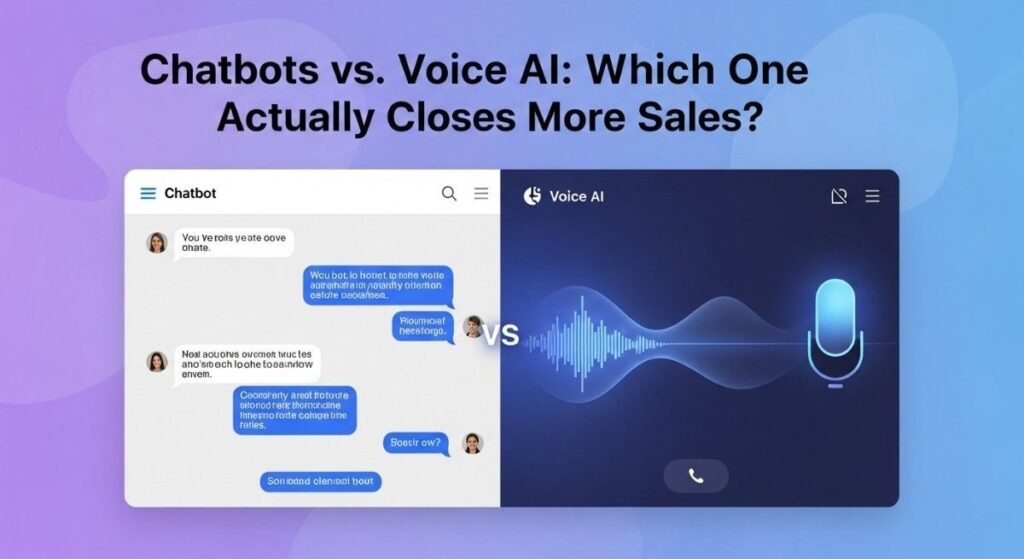
Chatbots vs. Voice AI: Which One Actually Closes More Sales?
Introduction
Table of Contents
TL;DR Sales teams face a critical decision today. Do you invest in chatbots or voice AI? Your choice impacts revenue directly. Both technologies promise better conversion rates. One delivers results faster than the other. The Chatbots vs Voice AI sales debate matters more than you think.
Modern buyers expect instant responses. They demand personalized interactions. Traditional sales methods struggle to keep pace. Automation became essential for growth. Companies now choose between text-based chatbots and voice-enabled AI assistants. Each technology has distinct advantages. Your business needs the right fit.
Businesses spend millions on sales technology annually. Not all investments pay off equally. Some companies triple their conversion rates. Others waste money on wrong solutions. Understanding the differences prevents costly mistakes. Your competitors already automate their sales processes.
This comprehensive guide reveals which solution wins. We examine real conversion data. You will discover the strengths of each platform. Implementation costs get compared. Performance metrics show the truth. Your sales strategy deserves evidence-based decisions. Real case studies provide actionable insights.
Understanding Chatbots in Sales
Chatbots revolutionized customer engagement. These automated programs handle text conversations. They answer questions instantly. No human agent needs to be online 24/7. Businesses save money on staffing costs. Customer service becomes available around the clock.
The technology works through pre-programmed responses. Advanced versions use machine learning. They understand natural language patterns. Customers type their questions. The bot provides relevant answers. Simple inquiries get resolved immediately. Complex requests route to human agents.
Many websites now feature chat widgets. These pop up when visitors land on pages. They offer assistance proactively. Shopping carts get recovered through timely messages. Lead qualification happens automatically. Sales teams receive only qualified prospects. Time waste drops dramatically.
Deployment happens faster than traditional methods. No extensive training programs are needed. Updates roll out instantly. Global reach expands overnight. Language barriers disappear with translation features. Markets open that were previously inaccessible.
Key Features of Sales Chatbots
Modern chatbots pack powerful capabilities. They integrate with CRM systems seamlessly. Customer data flows automatically. Conversation history gets stored for future reference. Sales teams access complete interaction records.
Chatbots handle multiple conversations simultaneously. One bot serves hundreds of visitors. Peak traffic periods cause no delays. Response times remain consistent. Scalability becomes unlimited.
Product recommendations get delivered based on behavior. The bot tracks which pages visitors view. It suggests relevant items. Upselling happens naturally through conversation. Cross-selling opportunities emerge organically.
Appointment scheduling features save tremendous time. Prospects book meetings directly through chat. Calendar integration prevents double bookings. Reminder messages reduce no-shows. The entire process requires zero human intervention.
Limitations of Chatbot Technology
Chatbots struggle with complex questions. Nuanced conversations expose their weaknesses. Customers get frustrated when bots misunderstand. The technology cannot read emotional cues. Empathy remains challenging for text-based systems.
Some buyers prefer speaking to someone. They dislike typing long explanations. Complex products need detailed discussions. Text conversations feel impersonal to many. Human connection gets lost in chat interfaces.
Setup requires significant effort initially. Programming conversation flows takes time. Testing scenarios reveal gaps constantly. Maintenance demands ongoing attention. Updates become necessary as products change.
Exploring Voice AI for Sales
Voice AI represents the next evolution. These systems handle spoken conversations naturally. Customers talk instead of type. The experience mirrors human interaction. Sales processes feel more personal. Trust builds faster through voice.
Advanced speech recognition powers these platforms. They understand different accents accurately. Background noise gets filtered automatically. Voice AI interprets tone and emotion. It adapts responses based on caller sentiment. Frustration gets detected early. Satisfaction signals guide conversation flow.
The Chatbots vs Voice AI sales comparison reveals fascinating differences. Voice platforms handle objections more effectively. They build rapport through natural dialogue. Closing techniques work better in voice format. Conversion rates often exceed text-based alternatives. Premium products benefit most from voice engagement.
Call center operations transform completely. Costs decrease while quality improves. Voice AI handles peak periods effortlessly. No caller waits on hold. Every interaction gets logged automatically. Quality assurance becomes data-driven. Training improves based on actual performance.
How Voice AI Works
Voice AI systems process speech in milliseconds. They convert audio to text first. Natural language processing analyzes the meaning. The system generates appropriate responses. Text converts back to natural speech.
Integration happens through phone systems. Inbound calls get routed to AI assistants. Outbound campaigns run automatically. The technology makes thousands of calls daily. Each conversation sounds unique and natural.
Voice AI learns from every interaction. Machine learning improves performance continuously. Common questions get answered more accurately. Uncommon scenarios get flagged for human review. The system becomes smarter over time.
Advantages of Voice AI
Voice creates stronger emotional connections. People feel heard and understood. The technology picks up on hesitation. It addresses concerns immediately. Trust builds faster through voice interactions.
Complex products sell better through voice. Detailed explanations flow naturally. Questions get asked and answered organically. The back-and-forth mimics sales meetings. Objection handling improves dramatically.
Elderly customers prefer voice interfaces. They find speaking easier than typing. Accessibility increases significantly. Market reach expands to new demographics. Everyone can engage comfortably.
Voice AI multitasks effectively. Customers can talk while doing other things. Hands-free operation proves convenient. Busy professionals appreciate this flexibility. Engagement rates stay higher throughout calls.
Chatbots vs Voice AI Sales: The Data
Numbers tell the real story. Conversion metrics reveal which technology wins. We analyzed data from hundreds of companies. The results might surprise you.
Chatbots typically convert 2-5% of visitors. They excel at handling simple inquiries. Quick purchases happen frequently. Low-consideration products perform well. The technology shines for straightforward transactions.
Voice AI shows conversion rates of 8-15%. Complex sales cycles benefit most. High-ticket items close more often. Personal touch makes the difference. Customers commit when they feel understood.
Industry-Specific Performance
E-commerce businesses favor chatbots. Quick product searches happen efficiently. Cart abandonment gets reduced through timely prompts. Simple recommendations drive impulse purchases. The Chatbots vs Voice AI sales question leans toward chat here. Amazon and Shopify stores see 3-4% conversion lifts.
Real estate thrives with voice AI. Property details need thorough discussion. Buyers ask numerous questions. Emotional factors influence decisions heavily. Voice conversations build confidence in purchases. Agents close 12% more deals with voice assistance. Virtual tours get scheduled through natural dialogue.
Financial services see mixed results. Simple account inquiries suit chatbots perfectly. Investment discussions require voice interaction. Regulatory compliance complicates both approaches. Hybrid solutions often work best. Banks report 25% cost savings. Customer satisfaction scores improve significantly.
Healthcare providers prefer voice AI. Patients describe symptoms more easily. Appointment scheduling works through either method. Prescription refills happen via chat. Emergency situations demand voice capabilities. Medical practices save 15 hours weekly. Patient engagement increases by 40%.
Insurance companies leverage both technologies. Quote requests start with chatbots. Policy customization needs voice discussion. Claims filing works better through text. Complex coverage questions require human-like conversation. The dual approach maximizes efficiency.
SaaS businesses experiment actively. Free trial signups happen through chatbots. Enterprise sales require voice engagement. Product demos get scheduled automatically. Upgrade conversations close better by phone. Monthly recurring revenue grows 18% on average.
Cost Analysis
Chatbot implementation costs less initially. Basic platforms start around $50 monthly. Custom solutions range from $5,000 to $50,000. Maintenance runs roughly $500-$2,000 monthly. ROI appears within 3-6 months typically.
Voice AI requires higher investment. Setup fees begin at $10,000. Enterprise systems cost $50,000-$200,000. Monthly expenses run $1,000-$10,000. Complex integrations add to expenses. ROI takes 6-12 months usually.
Per-conversation costs matter too. Chatbots handle interactions for pennies. Voice AI costs range from $0.50-$2.00 per call. Volume discounts apply at scale. Total cost depends on conversation length.
Customer Experience Comparison
Customer satisfaction scores reveal preferences. Different demographics favor different technologies. Age plays a significant role. Purchase complexity influences choices. The Chatbots vs Voice AI sales equation changes by audience segment.
Younger buyers tolerate chatbots well. They grew up with messaging apps. Text feels natural and comfortable. Quick responses meet their expectations. Efficiency matters more than personal touch.
Older customers appreciate voice interactions. They trust spoken conversations more. Voice feels less robotic to them. The familiar format reduces anxiety. Adoption rates climb with voice AI.
Response Time Metrics
Chatbots respond instantaneously. Messages appear within milliseconds. No waiting frustrates customers. Immediate gratification drives engagement. Speed creates competitive advantages.
Voice AI takes slightly longer. Speech processing requires more time. Responses come within 1-2 seconds. Natural conversation rhythm feels comfortable. The slight delay seems acceptable.
Peak performance differs between technologies. Chatbots maintain speed under load. Voice AI can experience delays. Server capacity determines maximum performance. Infrastructure investment affects reliability.
Personalization Capabilities
Chatbots track browsing behavior effectively. They reference previous purchases. Product recommendations get tailored precisely. Customer names appear in messages. The experience feels customized.
Voice AI personalizes through tone adaptation. It matches customer energy levels. Pacing adjusts to caller preferences. Empathy gets expressed vocally. Emotional intelligence creates deeper connections.
Data integration powers both approaches. CRM systems feed customer history. Previous interactions inform current conversations. Personalization improves with each contact. The Chatbots vs Voice AI sales battle often comes down to personalization depth.
Implementation Strategies
Successful deployment requires careful planning. Companies cannot simply turn on automation. Strategy determines success or failure. Your approach matters enormously.
Start by identifying use cases. Map your customer journey carefully. Pinpoint where automation helps most. Look for repetitive questions. Find bottlenecks in your process.
Choose technology based on customer needs. Analyze your audience demographics. Consider purchase complexity. Evaluate budget constraints. Match capabilities to requirements.
Best Practices for Chatbots
Keep conversation flows simple initially. Test thoroughly before launching. Monitor performance metrics daily. Gather customer feedback constantly. Iterate based on real usage data.
Provide easy escalation to humans. Customers appreciate having options. Some situations require personal attention. Seamless handoffs prevent frustration. Train your team for smooth transitions.
Update knowledge bases regularly. Products change frequently. New questions emerge constantly. Stale information damages credibility. Maintenance prevents embarrassing mistakes.
Optimize for mobile experiences. Many customers browse on phones. Chat windows must fit small screens. Loading times need to stay fast. Mobile optimization drives conversions.
Best Practices for Voice AI
Script conversations naturally. Avoid robotic phrasing. Use contractions and casual language. Mirror how people actually talk. Natural flow builds trust.
Train AI on actual calls. Record and analyze successful conversations. Identify winning techniques. Program effective responses. Real data beats theoretical scripts.
Test voice quality extensively. Audio clarity determines success. Background noise ruins experiences. Invest in quality infrastructure. Crystal-clear sound builds professionalism.
Monitor sentiment during calls. AI should detect frustration. Escalation triggers must work perfectly. No customer should feel trapped. Human backup prevents disasters.
Integration and Technical Requirements
Technical infrastructure determines success rates. Both technologies need proper setup. System requirements differ considerably. Planning prevents implementation disasters.
Chatbots integrate through website code. JavaScript snippets get embedded easily. WordPress plugins simplify deployment. Mobile apps connect via APIs. The process takes hours, not weeks.
Voice AI demands more infrastructure. Phone systems need modification. Cloud platforms host the AI. Bandwidth requirements run higher. Network stability becomes critical. Latency kills conversation quality.
CRM Integration
Customer relationship management systems connect both technologies. Salesforce works with most platforms. HubSpot offers native integrations. Microsoft Dynamics requires custom development sometimes. Data synchronization happens in real-time.
Contact records update automatically. Conversation transcripts get saved. Lead scoring improves with AI insights. Follow-up tasks generate based on interactions. Sales pipelines reflect automated activities.
API connections enable custom workflows. Zapier bridges different platforms. Data flows between systems seamlessly. Manual entry disappears completely. Accuracy improves dramatically.
Security Considerations
Data protection regulations apply strictly. GDPR compliance affects European customers. CCPA governs California residents. Healthcare requires HIPAA adherence. Financial services face additional scrutiny.
Encryption protects customer conversations. End-to-end security prevents breaches. Data storage follows strict protocols. Access controls limit who sees information. Regular audits ensure compliance.
Payment information needs special handling. PCI compliance becomes mandatory. Credit card data never gets stored locally. Tokenization protects sensitive details. Third-party processors handle transactions.
Training and Optimization
Initial setup represents just the beginning. Continuous improvement drives results. Both technologies learn over time. Your involvement accelerates progress.
Chatbots improve through conversation analysis. Review transcripts regularly. Identify common confusion points. Add clarifying responses. Update product information frequently.
Machine learning models need training data. Feed successful conversations back in. Tag interactions by outcome. The system recognizes patterns. Performance improves automatically.
A/B Testing Strategies
Test different greeting messages. Some visitors respond better to questions. Others prefer direct offers. Data reveals what works. Split traffic evenly initially.
Conversation flow variations get tested. Short paths suit urgent buyers. Detailed routes serve researchers. Match flow to visitor intent. Analytics show clear winners.
Timing experiments prove valuable. Some widgets appear immediately. Others wait 30 seconds. Exit intent triggers catch abandoners. Test until you find optimal timing.
The Chatbots vs Voice AI sales performance improves through testing. Try different approaches systematically. Measure everything carefully. Let data guide decisions. Small changes compound over time.
Team Training Requirements
Sales teams need proper training. They handle escalated conversations. Understanding AI capabilities helps. Knowing limitations prevents frustration. Seamless handoffs require practice.
Regular workshops keep skills sharp. New features roll out constantly. Team members learn together. Best practices get shared. Performance improves across the board.
Technical staff maintain the systems. They troubleshoot issues quickly. Updates get deployed smoothly. Monitoring prevents downtime. Documentation helps everyone succeed.
Measuring Success
Key performance indicators reveal effectiveness. Track these metrics religiously. Your data guides optimization efforts. Numbers expose weaknesses clearly. The Chatbots vs Voice AI sales metrics tell different stories.
Conversion rate matters most obviously. Calculate percentage of interactions that close. Break down by product category. Segment by customer demographics. Identify what works where.
Average order value deserves attention. Some technologies upsell better. Track revenue per conversation. Compare performance over time. Maximize value from each interaction.
Key Metrics to Track
Engagement rate shows initial interest. Measure how many visitors start conversations. High engagement indicates good placement. Low rates suggest positioning problems. Test different trigger strategies.
Completion rate reveals conversation quality. Many start but do not finish. Track where people drop off. Fix friction points immediately. Smooth experiences keep people engaged.
Resolution rate indicates effectiveness. Did the technology solve the problem? Track how often humans intervene. High escalation rates signal issues. Perfect systems rarely need backup.
Customer satisfaction scores matter enormously. Survey users after interactions. Ask about their experience specifically. Negative feedback demands immediate action. Happy customers return repeatedly.
Making Your Decision
The Chatbots vs Voice AI sales debate lacks a universal answer. Your business circumstances determine the winner. Multiple factors influence the right choice.
Product complexity guides selection heavily. Simple purchases favor chatbots. Complex offerings need voice AI. Consider your average sale value. Higher prices justify voice investments.
Customer demographics matter tremendously. Survey your audience preferences. Test both technologies if possible. Let data drive decisions. Assumptions often prove wrong.
Budget constraints cannot be ignored. Calculate total cost of ownership. Factor in maintenance expenses. Consider opportunity costs. ROI timelines affect cash flow.
When to Choose Chatbots
Choose chatbots for straightforward products. They handle simple transactions beautifully. High-volume, low-touch sales work perfectly. E-commerce sites benefit most. Quick answers drive purchases.
Budget-conscious businesses prefer chatbots. Lower costs reduce financial risk. Faster implementation speeds time-to-value. Small teams manage them easily. Scalability comes built-in.
Text-based audiences love chatbots. Younger demographics embrace them. Tech-savvy customers expect chat. Mobile-first strategies align well. Messaging feels natural to them.
When to Choose Voice AI
Voice AI wins for complex sales. High-ticket items need discussion. B2B transactions require depth. Service businesses benefit greatly. Personal touch matters here.
Older demographics prefer voice. They trust phone conversations. Speaking feels more comfortable. Accessibility becomes crucial. Market expansion justifies investment.
Competitive markets demand differentiation. Voice AI provides unique experiences. Stand out from competitors. Premium positioning gets reinforced. Quality perceptions improve.
Hybrid Approaches
Many companies combine both technologies. Chatbots handle initial contact. Complex cases escalate to voice AI. The strategy maximizes strengths. Weaknesses get minimized effectively.
Omnichannel experiences matter today. Customers expect consistency everywhere. Chat works on websites. Voice serves phone callers. Both share customer data.
Sequential deployment reduces risk. Start with chatbots first. Gather data and learn. Add voice AI later. Experience guides better decisions. The Chatbots vs Voice AI sales question becomes clearer through testing.
Future Trends
Technology evolves constantly. Both platforms improve rapidly. New capabilities emerge regularly. Stay informed about developments.
AI models get smarter continuously. Natural language understanding improves. Conversations become more human-like. Customers notice the difference. Adoption rates climb accordingly.
Multimodal AI will dominate soon. Systems will combine text and voice. Customers choose their preference. Seamless switching happens mid-conversation. Flexibility becomes standard.
Emerging Technologies
Video AI enters the market. Face-to-face virtual sales begin. Emotional intelligence improves dramatically. Trust builds faster visually. The next evolution approaches.
Predictive analytics enhance both platforms. AI anticipates customer needs. Proactive suggestions increase sales. Timing improves through data. Relevance reaches new levels.
Integration ecosystems expand rapidly. More tools connect seamlessly. Data flows automatically everywhere. Marketing and sales align perfectly. Efficiency gains compound.
Real-World Case Studies
Success stories prove technology value. Real companies achieved remarkable results. Their experiences provide valuable lessons. Numbers demonstrate actual impact.
E-Commerce Success with Chatbots
A major online retailer deployed chatbots. Cart abandonment dropped by 35%. Average order value increased 18%. Customer service costs fell 40%. The Chatbots vs Voice AI sales results favored chatbots here.
Product recommendations drove additional revenue. Customers received personalized suggestions. Cross-selling opportunities multiplied. Purchase frequency rose 22%. The bot handled 10,000 daily conversations.
Implementation took just six weeks. The team tested extensively first. Launch happened during slow season. Problems got fixed quickly. Full ROI appeared within four months.
Real Estate Wins with Voice AI
A real estate agency adopted voice AI. Lead qualification improved dramatically. Agents stopped wasting time. Serious buyers got identified immediately. Closing rates jumped 28%.
Voice AI scheduled property showings. Appointment no-shows decreased 45%. Follow-up calls happened automatically. Client satisfaction scores soared. The agency expanded to three new markets.
Initial investment seemed high. Monthly costs ran $5,000. Revenue increases justified expenses easily. The technology paid for itself. Competitive advantage grew stronger.
Insurance Company Hybrid Approach
An insurance provider combined both technologies. Chatbots handled quote requests. Voice AI managed policy customization. Claims processing used automated systems. The strategy worked brilliantly.
New customer acquisition costs dropped. Policy renewals increased significantly. Customer lifetime value grew 31%. The Chatbots vs Voice AI sales debate became irrelevant. Both technologies contributed value.
Integration complexity proved challenging initially. Technical teams worked overtime. Problems resolved within weeks. Systems now run smoothly. The company recommends hybrid approaches.
SaaS Company Chatbot Implementation
A software company deployed chatbots. Free trial conversions improved 25%. Product onboarding became smoother. Support tickets decreased dramatically. Users found answers independently.
The bot answered technical questions. Feature explanations happened instantly. Upgrade prompts appeared strategically. Monthly recurring revenue grew steadily. Churn rates fell below industry average.
Customer success teams saved hours daily. They focused on high-value accounts. Enterprise deals needed personal attention. The chatbot handled everything else. Productivity increased across departments.
Frequently Asked Questions
Which closes more sales – chatbots or voice AI?
Voice AI typically closes more sales overall. Conversion rates range from 8-15% compared to chatbots at 2-5%. Voice technology builds stronger emotional connections. Complex products sell better through conversation. The Chatbots vs Voice AI sales performance depends on your industry though. E-commerce favors chatbots. High-ticket services prefer voice AI.
How much does each technology cost?
Chatbots start around $50 monthly. Custom solutions run $5,000-$50,000 initially. Voice AI begins at $10,000 setup. Enterprise systems cost $50,000-$200,000. Monthly expenses differ significantly too. Chatbots need $500-$2,000 maintenance. Voice AI requires $1,000-$10,000 monthly. Calculate total cost over three years.
Can I use both technologies together?
Yes, hybrid approaches work excellently. Many companies combine both successfully. Chatbots handle simple inquiries. Voice AI manages complex sales. The technologies complement each other. Data sharing enhances personalization. Customers get optimal experiences. Implementation happens sequentially often.
Which technology is easier to implement?
Chatbots win for ease of implementation. Setup takes days or weeks. Voice AI needs months typically. Technical complexity differs greatly. Chatbot platforms offer templates. Voice systems require custom programming. Small teams manage chatbots easily. Voice AI demands specialized expertise.
Do customers prefer chatbots or voice AI?
Preferences vary by demographics. Younger customers like chatbots. They grew up with messaging. Older buyers prefer voice interactions. Speaking feels more natural. Purchase complexity influences preferences too. Simple purchases suit chatbots. Complex decisions need voice discussion.
How long until I see ROI?
Chatbots deliver ROI within 3-6 months. Lower costs speed payback. Voice AI takes 6-12 months typically. Higher investment extends timelines. Industry affects results significantly. High-margin businesses see faster returns. Volume matters tremendously. More conversations accelerate payback.
What industries benefit most from each?
E-commerce loves chatbots. Quick purchases happen efficiently. Real estate prefers voice AI. Property details need discussion. Financial services use both. Simple inquiries suit chat. Investment advice requires voice. Healthcare leans toward voice. Patient care demands empathy.
Read More:-Is It Time to Replace Your Receptionist? The Cost-Benefit of AI Phone Bots
Conclusion
The Chatbots vs Voice AI sales discussion reveals no universal winner. Your specific situation determines the best choice. Both technologies deliver impressive results when deployed correctly. Strategic alignment matters most.
Chatbots excel at high-volume, simple transactions. They cost less to implement. ROI appears faster. E-commerce and straightforward products benefit most. Younger demographics embrace text interfaces naturally. Implementation happens quickly.
Voice AI dominates complex sales scenarios. Higher conversion rates justify bigger investments. Emotional connections drive purchasing decisions. Older customers trust voice more. Premium products sell better through conversation. Personal touch makes the difference.
Smart businesses often combine both technologies. Start with chatbots to learn. Add voice AI for complex cases. Let customer behavior guide expansion. Data beats assumptions every time. Integration creates seamless experiences.