
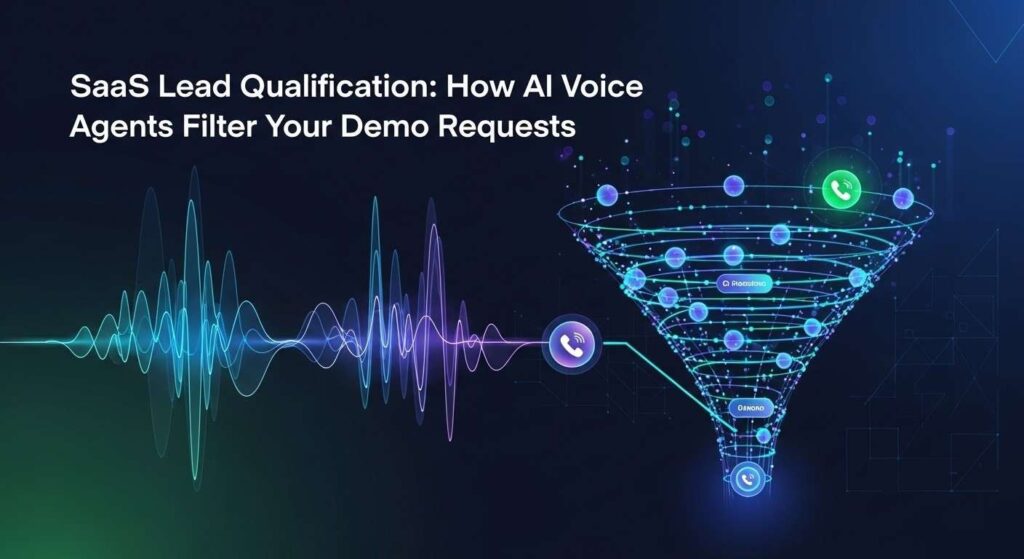
SaaS Lead Qualification: How AI Voice Agents Filter Your Demo Requests
Introduction
Table of Contents
TL;DR Your sales team drowns in demo requests every single day. Not all of them deserve your time.
SaaS lead qualification determines which prospects actually convert into paying customers. Your team wastes hours on calls with people who will never buy.
AI voice agents now handle the initial screening process automatically. They ask the right questions before your sales team gets involved.
This technology saves time while improving the quality of leads reaching your pipeline. Let’s explore how it transforms your demo request workflow.
The Cost of Poor Lead Qualification
Sales teams spend roughly 40% of their time on unqualified leads. That represents massive wasted effort and lost revenue.
Your best closers talk to tire-kickers instead of decision-makers. The opportunity cost compounds over time.
Poor qualification creates frustration across your entire organization. Marketing blames sales for not closing enough deals. Sales blames marketing for sending bad leads.
Understanding the Traditional Demo Request Problem
Someone fills out your demo request form at 2 AM. They provide minimal information in required fields.
Your sales team sees a new lead notification in the morning. They immediately schedule a demo without asking qualifying questions.
The demo happens three days later. Your rep spends 45 minutes presenting features to someone with zero budget.
This scenario plays out hundreds of times at growing SaaS companies. The inefficiency drains resources that could drive actual growth.
The Hidden Costs Nobody Talks About
Calendar chaos emerges when your team books every single demo request. Your best reps fill their schedules with low-quality meetings.
Context switching between qualified and unqualified prospects reduces overall productivity. Sales reps lose momentum constantly.
Your demo no-show rate probably hovers around 30-40%. Those ghost appointments represent hours of wasted preparation time.
Engineering and product teams build features based on feedback from people who never intended to buy. Strategic direction suffers from poor signal quality.
What Is SaaS Lead Qualification?
SaaS lead qualification means determining whether a prospect matches your ideal customer profile. You evaluate their fit before investing significant sales resources.
The process examines company size, budget, authority, need, and timeline. These factors predict conversion likelihood accurately.
Qualified leads progress through your pipeline efficiently. Unqualified prospects exit early without wasting anyone’s time.
Traditional Qualification Frameworks
BANT remains the most common framework for decades. Budget, Authority, Need, and Timeline provide basic qualification criteria.
MEDDIC offers a more sophisticated approach for enterprise sales. Metrics, Economic Buyer, Decision Criteria, Decision Process, Identify Pain, and Champion create comprehensive qualification.
CHAMP focuses on challenges before discussing budget. Challenges, Authority, Money, and Prioritization reverse the traditional order.
Your framework choice depends on sales cycle complexity and average deal size. Simple products need simple qualification.
Why Qualification Matters More for SaaS
SaaS companies face unique challenges around lead quality. The self-service nature of software attracts window shoppers easily.
Free trials generate high volumes of interest with low conversion rates. Your team needs to identify serious buyers quickly.
Recurring revenue models require careful customer selection. Bad-fit customers churn within months.
SaaS lead qualification directly impacts customer lifetime value and retention metrics. Early qualification prevents downstream problems.
Enter AI Voice Agents
Artificial intelligence now handles conversational interactions that once required human effort. Voice agents conduct natural phone conversations autonomously.
The technology understands speech, processes information, and responds appropriately in real-time. Modern systems sound remarkably human during interactions.
Companies deploy AI voice agents for customer service, appointment scheduling, and sales qualification. The technology excels at repetitive conversational workflows.
How Voice AI Technology Works
Natural language processing converts speech into text that computers understand. The system analyzes words, phrases, and intent behind them.
Machine learning models generate appropriate responses based on conversation context. The AI selects from thousands of possible reply options instantly.
Text-to-speech synthesis creates natural-sounding voice output. Modern voices include personality, emotion, and conversational cadence.
The entire process happens in milliseconds during live conversations. Prospects rarely realize they’re speaking with AI initially.
The Evolution of Sales Automation
Early sales automation focused on email sequences and basic chatbots. These tools handled simple, text-based interactions only.
Voice technology represents the next evolution in sales automation capability. Phone conversations contain richer information than form submissions.
AI voice agents combine the scale of automation with the depth of human conversation. You get qualification insights that forms never capture.
The technology continues improving rapidly. Today’s voice agents handle increasingly complex qualification scenarios effectively.
How AI Voice Agents Handle SaaS Lead Qualification
AI voice agents call every demo request within minutes of form submission. Speed matters enormously for lead conversion rates.
The agent introduces itself and explains the purpose of the call. Transparency builds trust from the first moment.
The Qualification Conversation Flow
The AI starts by confirming basic information from the form submission. Name, company, and role verification happens first.
Questions progress naturally from general to specific. The conversation feels organic rather than robotic.
The agent adapts questions based on previous answers. Someone mentioning budget constraints triggers different follow-up questions than someone emphasizing urgency.
SaaS lead qualification through AI captures information your forms miss entirely. Voice conversations reveal context that text fields cannot.
Key Qualification Questions AI Asks
Company size and team structure questions identify whether the prospect matches your ICP. Employees, departments, and organizational complexity matter significantly.
Current solution questions reveal whether they’re replacing existing software. Migration complexity affects closing probability.
Pain points and challenges surface the urgency behind their demo request. Generic interest differs dramatically from acute pain.
Budget availability and approval process questions separate serious buyers from researchers. The AI phrases these sensitively to avoid offending prospects.
Timeline questions determine whether opportunities align with your sales capacity. Deals closing in 30 days require different handling than 12-month evaluations.
Decision-making process questions identify all stakeholders who need involvement. Single evaluators rarely close in B2B SaaS contexts.
Scoring and Routing Logic
The AI assigns qualification scores based on responses throughout the conversation. Each answer contributes to an overall lead quality rating.
High-scoring leads route immediately to senior sales representatives. These prospects deserve your best closers immediately.
Medium-scoring leads enter nurture sequences with targeted content. They need education before sales engagement.
Low-scoring leads receive automated resources without human involvement. Your team avoids wasting time on poor-fit prospects.
The scoring algorithm improves continuously through machine learning. The system identifies which qualification factors predict actual conversions.
Benefits of AI-Powered Lead Qualification
Your sales team focuses exclusively on high-quality opportunities. Demo calendars fill with prospects who actually convert.
Response speed improves dramatically when AI calls leads within minutes. Fast follow-up significantly increases connection and qualification rates.
Scaling Without Hiring
Traditional qualification requires hiring SDRs as lead volume grows. Each SDR handles perhaps 100-150 conversations monthly.
AI voice agents handle thousands of qualification calls simultaneously. Your qualification capacity becomes essentially unlimited.
Seasonal spikes in demo requests don’t overwhelm your team anymore. The AI scales instantly to match demand fluctuations.
Geographic and timezone coverage becomes 24/7 without shift work. International prospects receive immediate attention regardless of local time.
Consistency Across Every Interaction
Human qualifiers have good days and bad days. Mood, energy, and personal issues affect conversation quality.
AI voice agents deliver identical qualification quality on call 10,000 as on call 1. Performance never degrades from fatigue or frustration.
Every prospect hears the same questions in the same friendly tone. Consistency eliminates qualification bias and ensures fair evaluation.
Your qualification criteria apply uniformly across all leads. Personal preferences and gut feelings don’t influence scoring anymore.
Data Capture and Analysis
AI voice agents record and transcribe every qualification conversation automatically. You build a searchable database of prospect interactions.
The system identifies patterns in successful versus unsuccessful qualification calls. You learn which questions predict conversion most accurately.
Objection tracking reveals common concerns before prospects reach sales demos. Your team prepares better responses to frequent pushback.
SaaS lead qualification data feeds directly into your CRM without manual entry. Sales reps see complete context before their first prospect interaction.
Cost Efficiency Compared to Human Teams
SDR salaries typically range from $40,000 to $70,000 annually plus benefits. Teams of 5-10 SDRs cost $250,000 to $500,000 yearly.
AI voice agent platforms cost a fraction of human team expenses. Most companies see 60-80% cost reduction for equivalent qualification volume.
Training time disappears when AI handles qualification. New qualification criteria deploy instantly across all conversations.
Turnover costs vanish since AI agents never quit. Knowledge retention becomes permanent rather than walking out the door.
Implementation Considerations
Successful AI voice agent deployment requires careful planning and execution. Technology alone doesn’t guarantee results.
Defining Your Qualification Criteria
Start by analyzing your best customers. Identify common characteristics across your highest-value accounts.
Document the specific questions that predict deal closure. Your AI qualification script should mirror successful human conversations.
Establish clear scoring thresholds for different lead quality tiers. Define what constitutes A-tier, B-tier, and C-tier prospects objectively.
Test your criteria against historical lead data. Validate that your scoring methodology actually predicts conversions accurately.
Choosing the Right AI Platform
Voice quality matters enormously for prospect experience. Test multiple platforms to evaluate naturalness and conversational ability.
Integration capabilities determine how smoothly AI fits into existing workflows. CRM synchronization and routing automation need to work flawlessly.
Customization flexibility allows you to adapt the system to your specific qualification needs. One-size-fits-all solutions rarely work well.
Analytics and reporting features should provide actionable insights. You need visibility into qualification performance and improvement opportunities.
Training Your AI Voice Agent
Feed the system examples of excellent qualification conversations. The AI learns from your best human interactions.
Provide lists of industry-specific terminology and company-specific jargon. Context understanding improves when the AI knows your vocabulary.
Test extensively with internal team members before deploying to real prospects. Catch awkward phrasing and logic errors in safe environments.
Iterate based on early conversation recordings. The first 100 calls reveal improvement opportunities you couldn’t anticipate.
Integration with Existing Sales Stack
Your AI qualification system needs bidirectional CRM integration. Lead data flows in and qualification results flow back automatically.
Calendar systems should connect for seamless demo scheduling. Qualified leads book directly onto appropriate rep calendars.
Marketing automation platforms need qualification data to refine nurture sequences. Lead scoring in your MAP should reflect AI qualification insights.
SaaS lead qualification works best when integrated into your complete revenue technology stack. Isolated tools create data silos and workflow friction.
Best Practices for AI Voice Qualification
Transparency with prospects builds trust from the start. The AI should identify itself as an automated assistant clearly.
Offer the option to speak with a human if prospects prefer. Some people simply won’t engage with AI agents.
Optimizing the Conversation Script
Keep opening statements brief and friendly. Long introductions cause prospects to lose interest quickly.
Ask one question at a time rather than combining multiple inquiries. Simple questions get better responses than complex multi-part asks.
Use natural language that matches how humans actually speak. Formal corporate language sounds robotic even with good voice synthesis.
Include conversational acknowledgments that show active listening. Simple phrases like “I understand” or “that makes sense” improve flow significantly.
Handling Objections and Concerns
Program the AI to acknowledge concerns empathetically before addressing them. Validation diffuses tension effectively.
Provide clear explanations for why you’re asking qualification questions. Prospects accept probing when they understand the reasoning.
Offer value during the qualification conversation itself. Share relevant insights or resources that help regardless of qualification outcome.
Never argue with prospects who express frustration with the qualification process. Route difficult conversations to humans quickly.
Continuous Improvement Process
Review random samples of qualification calls weekly. Listen for awkward moments, confused prospects, or missed opportunities.
Analyze which questions generate the most valuable qualification insights. Double down on high-signal questions and eliminate low-value ones.
Track conversion rates from qualified leads to closed deals. Your qualification accuracy should improve month over month.
Gather feedback from sales reps about lead quality. Their input reveals whether qualification criteria need adjustment.
Real-World Results and Case Studies
A B2B marketing automation company reduced SDR headcount from 8 to 2 after deploying AI qualification. Demo quality improved while costs decreased 70%.
The AI handled 3,200 monthly qualification calls compared to 800 with the human team. Sales reps reported better-prepared prospects in demos.
Improvement Metrics to Track
Demo show rate typically increases 15-25% when AI qualifies leads quickly. Fast follow-up dramatically reduces ghosting.
Sales cycle length often decreases 20-30% with better qualification. Reps spend less time educating poor-fit prospects.
Win rates improve 10-20% when qualification filters effectively. Your team focuses energy on closeable opportunities.
SaaS lead qualification ROI becomes measurable through concrete pipeline metrics. The business case builds itself through hard data.
Common Implementation Challenges
Some prospects react negatively to AI initially. The technology still carries stigma in certain demographics.
Voice recognition struggles with heavy accents or poor phone connections. Backup human qualification routes handle these edge cases.
Integration complexity delays deployment at companies with custom CRM configurations. Budget extra time for technical implementation.
Change management within sales teams requires careful handling. Reps worry about AI replacing them entirely.
The Human Element Still Matters
AI voice agents excel at structured qualification conversations. They handle routine screening with superhuman consistency.
Complex enterprise sales situations still need human intuition and relationship building. AI augments rather than replaces skilled sales professionals.
When to Route to Humans Immediately
High-value enterprise opportunities deserve immediate human attention. Strategic accounts need personal touches from the start.
Existing customer expansion opportunities should skip AI qualification entirely. You already know these accounts intimately.
Inbound leads from targeted accounts on your hit list warrant special treatment. Personal outreach shows respect for priority prospects.
Confused or frustrated prospects need human empathy and flexibility. AI lacks the emotional intelligence to rescue rocky conversations.
Training Sales Teams to Work with AI Qualification
Help reps understand that AI filters save their time for meaningful work. Frame the technology as a tool that elevates their role.
Provide visibility into qualification conversations through shared recordings. Reps learn about prospects before demos begin.
Establish feedback loops where sales outcomes improve AI qualification. The human-AI collaboration should strengthen over time.
Celebrate wins that resulted from excellent AI qualification. Recognition reinforces the value of the new workflow.
Privacy and Compliance Considerations
Recording qualification calls requires proper consent in many jurisdictions. Your AI agent must clearly state that recording will occur.
Data handling practices need to comply with GDPR, CCPA, and other privacy regulations. Prospect information requires appropriate protection.
Building Trust Through Transparency
Explain clearly on your demo request form that AI may conduct initial screening. Surprise erodes trust unnecessarily.
Provide easy ways for prospects to request human contact instead. Forced AI interaction creates negative brand impressions.
Use collected data only for stated qualification purposes. Mission creep damages relationships and violates regulations.
Allow prospects to request deletion of their qualification conversation data. Privacy rights extend beyond just form submissions.
The Future of SaaS Lead Qualification
Voice AI technology improves rapidly quarter over quarter. Tomorrow’s systems will handle increasingly sophisticated qualification scenarios.
Emotional intelligence capabilities will allow AI to detect frustration, excitement, and confusion in prospect voices. Response adaptation will become more nuanced.
Emerging Capabilities on the Horizon
Video qualification calls will combine voice AI with visual processing. The system will read body language and facial expressions during qualification.
Multilingual qualification will expand as language models improve. A single AI agent will qualify prospects in dozens of languages fluently.
Predictive qualification will analyze digital behavior patterns before initial contact. The AI will know significant context before the first conversation.
SaaS lead qualification will become nearly instantaneous as systems process information faster. The delay between demo request and qualification will measure in seconds rather than hours.
Preparing Your Organization for AI-First Qualification
Invest in understanding AI capabilities and limitations now. Early adopters gain competitive advantages that compound over time.
Build qualification data infrastructure that AI systems can leverage. Clean CRM data and documented ideal customer profiles become even more valuable.
Develop internal AI literacy across revenue teams. Everyone should understand how these systems work and improve.
Test pilot programs with small lead volumes before full deployment. Learning happens faster with real prospects than theoretical planning.
Frequently Asked Questions
Does AI qualification sound robotic to prospects?
Modern AI voice agents sound remarkably natural during conversations. Most prospects don’t realize they’re speaking with AI initially. Voice synthesis technology has improved dramatically in recent years. The systems include natural pauses, conversational cadence, and even personality traits. Awkwardness appears mainly when the AI encounters unexpected responses it hasn’t been trained to handle. Proper implementation and training minimize these moments significantly.
How do AI agents handle prospects who refuse to answer qualification questions?
AI systems can be programmed with graceful escalation paths. The agent first explains why qualification helps ensure the demo provides value. If prospects still resist, the system can offer to schedule with a human team member directly. Some platforms allow prospects to skip qualification and book demos anyway. Your business rules determine how pushy or flexible qualification becomes. The key is respecting prospect preferences while protecting your team’s time.
Can AI voice agents qualify for complex enterprise sales?
Enterprise qualification requires more sophisticated conversation logic. AI agents can handle initial screening even for complex sales. They identify basic fit factors and gather preliminary information efficiently. High-value enterprise opportunities should route to experienced human qualifiers quickly. The AI saves time on obvious poor fits while flagging potential strategic accounts. Hybrid approaches work best for enterprise SaaS lead qualification scenarios.
What happens when the AI encounters unexpected questions or objections?
Well-designed AI qualification systems include fallback responses for unfamiliar scenarios. The agent might acknowledge the question and promise a human will follow up. Advanced systems can route to human backup in real-time for seamless handoff. Every unexpected situation improves the AI through additional training. The system learns to handle new scenarios automatically over time. Early implementation requires monitoring to catch and address these gaps.
How long does it take to implement AI voice qualification?
Basic implementation typically requires 2-4 weeks from decision to first qualified lead. This includes platform selection, integration setup, and script development. Complex CRM integrations or custom workflows extend timelines to 6-8 weeks. Training the AI on your specific qualification criteria takes days rather than months. Most companies see value within the first month of deployment. Full optimization happens over 3-6 months as you refine approaches.
Will prospects get angry about talking to AI instead of humans?
Some prospects prefer human interaction and react negatively to AI. Transparency from the start reduces this friction significantly. Offering easy escalation to human alternatives prevents most frustration. Younger demographics generally accept AI qualification without concern. Older decision-makers sometimes prefer traditional qualification approaches. Your target market demographics should inform deployment strategy and tone.
How does AI qualification integrate with existing lead scoring?
AI qualification data should feed directly into your existing lead scoring model. The qualification conversation provides rich behavioral and firmographic signals. These inputs improve scoring accuracy dramatically compared to form data alone. Most platforms offer native CRM integrations that sync scores automatically. The AI essentially becomes your most consistent and thorough lead scoring analyst. Historical scoring models can be validated and refined using AI qualification insights.
What’s the ROI timeline for AI voice qualification?
Most companies see positive ROI within 90 days of implementation. Time savings appear immediately as the AI handles qualification volume. Sales efficiency improvements show up in pipeline metrics within 60 days. Hard cost savings from reduced SDR headcount take longer to realize. Full ROI often reaches 300-500% within the first year. The exact timeline depends on lead volume and implementation quality.
Read More:-Chatbots vs. Voice AI: Which One Actually Closes More Sales?
Conclusion
SaaS lead qualification transforms completely when AI voice agents handle initial screening. Your sales team focuses exclusively on prospects who actually convert into customers.
The technology scales infinitely without the cost and complexity of human teams. Thousands of qualification conversations happen simultaneously across timezones.
Implementation requires thoughtful planning around qualification criteria and conversation design. Simply deploying AI without strategy produces disappointing results.
The best implementations combine AI efficiency with human expertise strategically. Voice agents handle routine screening while humans build relationships with qualified prospects.
Demo request volume no longer limits your sales capacity. The AI qualifies everyone immediately regardless of how many forms get submitted.
Your sales reps enter every demo armed with complete context from qualification conversations. They know pain points, budget, timeline, and decision process before saying hello.
Poor-fit prospects exit your funnel early without wasting anyone’s time. This improves the experience for everyone involved in the process.
Cost efficiency improves dramatically when AI replaces teams of SDRs performing qualification. The savings fund other growth investments across your organization.
Data quality increases when every qualification conversation follows the same rigorous process. Inconsistent human qualification creates gaps in your understanding.
The competitive advantage goes to companies that adopt AI qualification early. Your competitors waste resources on unqualified leads while you focus on winners.
Start with small pilot programs to build confidence and learn what works. Test with a portion of your demo requests before full deployment.
Monitor results closely and iterate based on actual conversation outcomes. The first implementation won’t be perfect immediately.
Your qualification criteria will evolve as you learn which factors predict success. AI systems adapt much faster than retraining human teams.
SaaS lead qualification through AI voice agents represents the future of efficient sales operations. Early adopters gain advantages that compound over quarters and years.
The question isn’t whether to implement AI qualification eventually. The question is whether you’ll lead or follow this inevitable transition.
Your demo requests deserve intelligent screening before they reach your best closers. AI voice agents provide that screening at scale and consistency humans cannot match.