
AI Voice Agents vs. Traditional IVR: Why Your Customers Hate Your Current Menu
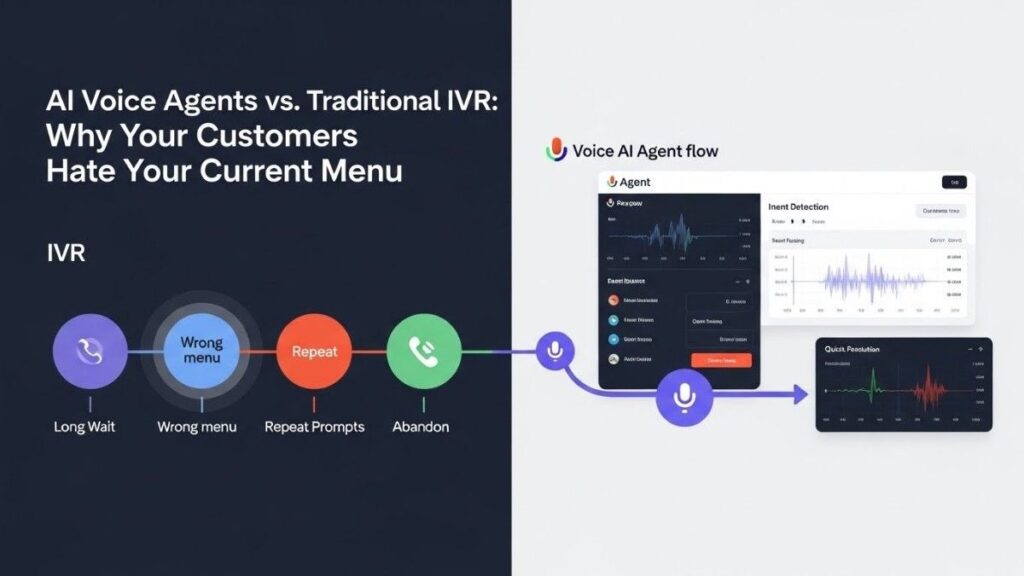
Introduction: The Phone Call Nobody Wants to Make
Table of Contents
TL;DR You’ve been there. Calling customer service feels like entering a maze with no exit.”Press 1 for billing. Press 2 for technical support. Press 3 to hear these options again.”Your blood pressure rises. The robotic voice drones on. You’ve already pressed three buttons and still haven’t reached a human.This is the reality of traditional IVR systems. They frustrate customers daily. They cost businesses millions in lost sales and damaged reputations.But there’s a better way. AI voice agents vs Traditional IVR isn’t just a technology comparison. It’s a battle between customer satisfaction and customer frustration.The old phone menus are dying. Smart businesses are already making the switch. Here’s why your company should too.
What Is Traditional IVR and Why Was It Created?
Interactive Voice Response (IVR) systems arrived in the 1980s. Companies wanted to reduce staffing costs. They needed a way to route calls automatically.
The concept seemed brilliant at the time. Customers would navigate pre-recorded menus. They’d reach the right department without human intervention. Companies would save money on support staff.
Early IVR systems used touch-tone technology. Callers pressed numbers on their keypad. The system routed them based on those inputs.
Later versions added basic speech recognition. Callers could say “billing” or “support” instead of pressing buttons. The technology felt modern and efficient.
Banks adopted IVR for account balances. Airlines used it for flight information. Utility companies deployed it for payment processing.
For businesses, the math looked perfect. One IVR system could handle hundreds of calls simultaneously. No salaries, benefits, sick days.
But there was a problem. IVR designers built these systems for business efficiency. They forgot about the human on the other end of the line.
The menus grew longer. The options multiplied. The path to a real person became increasingly complex.
Customers started hating phone calls to customer service. The very tool meant to improve service was destroying it.
The Fatal Flaws of Traditional IVR Systems
Rigid Menu Structures That Don’t Match Real Problems
Traditional IVR operates on a fixed decision tree. You must choose from predefined options. Your actual problem doesn’t matter.
Calling about a billing error on a cancelled service? Good luck finding that specific menu path. The IVR has boxes. Your issue doesn’t fit in any of them.
Customers waste time navigating irrelevant options. They make wrong choices because the right one doesn’t exist. Then they start over. Frustration builds.
The system can’t adapt. It can’t understand context. It simply plays the same menu to everyone regardless of their needs.
Zero Understanding of Natural Language
Early speech recognition in IVR was terrible. Modern versions are only marginally better.
Try explaining a complex issue to an IVR system. You can’t. The system listens for specific keywords only. Anything outside its limited vocabulary fails.
“I need to update my payment method” might work. “My credit card was stolen and I need to change how you charge me” probably won’t.
The technology can’t grasp meaning. It matches words to commands. That’s not understanding. That’s pattern matching.
Customers simplify their speech unnaturally. They speak in choppy fragments. They feel like they’re talking to a brick wall. Because they are.
Endless Loops and Dead Ends
“I’m sorry, I didn’t understand that. Please try again.”
This phrase haunts customer service calls. IVR systems trap people in loops. The same message repeats. The same options cycle through. No progress happens.
Even worse are the dead ends. You navigate through four menu levels. You finally select your option. The system says “That service is unavailable” and disconnects.
These aren’t rare glitches. They’re standard IVR experiences. Millions of customers encounter them daily.
Inability to Handle Complex Queries
Traditional IVR excels at simple tasks. Check your account balance? Easy. Pay a bill? No problem. Anything beyond that? Disaster.
Real customer problems are messy. They involve multiple issues,require context and understanding and need flexible solutions.
IVR can’t do flexible. A customer might need to report a defective product, arrange a return, and update their shipping address. That’s three separate menu trees. The IVR will make them hang up and call back twice more.
The system treats every call as a single-issue transaction. Customer relationships are complex. IVR isn’t built for complexity.
Creating Customer Rage Instead of Resolution
Studies show IVR systems are among the most hated aspects of customer service. People would rather wait on hold for a human than navigate another phone menu.
The rage is real and measurable. Customers who struggle with IVR are more likely to churn. They’re more likely to leave negative reviews. They’re more likely to tell others about their bad experience.
This emotional damage has a cost. Frustrated customers don’t just leave. They actively campaign against your brand. One terrible IVR experience creates dozens of lost opportunities.
What Are AI Voice Agents and How Do They Work?
AI voice agents vs IVR represents a fundamental shift in technology approach. These aren’t upgraded menu systems. They’re intelligent conversation partners.
AI voice agents use natural language processing (NLP). They understand what people actually say. They grasp context, intent, and nuance.
The technology combines several components. Speech recognition converts voice to text. Natural language understanding interprets meaning. Machine learning predicts what the customer needs. Speech synthesis responds in natural language.
Unlike IVR, AI voice agents don’t force customers down predetermined paths. They have conversations,ask clarifying questions ,adapt based on responses.
The agent accesses your business systems in real-time. It pulls customer history, checks inventory, processes transactions. All while talking naturally.
Modern AI voice agents can handle interruptions. They remember earlier parts of the conversation. They adjust their responses based on customer emotion and urgency.
The technology has reached a tipping point. AI voice agents now sound remarkably human. They understand accents and dialect,They handle background noise. They work across multiple languages.
For customers, the experience is transformative. They explain their problem in normal language. The agent understands immediately. Resolution happens in one call. No transfers,menus, frustration.
AI Voice Agents vs IVR: The Key Differences That Matter
Natural Conversation vs. Menu Navigation
Traditional IVR demands that customers adapt to the system. Press this. Say that. Follow the structure.
AI voice agents adapt to customers. They accept free-form speech,understand variations in phrasing, work with how people naturally communicate.
A customer can say “I moved last week and need to change where you send my packages.” An AI agent understands this completely. An IVR system would force them to navigate to account settings, then shipping preferences, then address updates.
The difference is fundamental. One system respects human communication. The other forces robotic interaction.
Context Awareness vs. Isolated Transactions
IVR treats every interaction as standalone. Call history doesn’t matter. Previous conversations don’t exist. Each call starts from zero.
AI voice agents maintain context throughout the conversation. They remember what was said thirty seconds ago, connect related topics, build on previous information.
This context extends to customer history. The AI knows you’re a long-time customer. It sees your recent purchases. It understands your preferences. The conversation starts from an informed position.
Intelligent Problem-Solving vs. Limited Options
When faced with an unexpected query, IVR fails. It has no ability to reason or problem-solve. If your issue isn’t in the menu, you’re stuck.
AI voice agents approach problems like skilled human agents. They analyze the situation, consider multiple solutions, propose alternatives if the first approach won’t work.
A customer might ask for something impossible. An IVR would just say no. An AI agent explains why it’s not possible and suggests what can be done instead.
Emotional Intelligence vs. Robotic Responses
IVR has no concept of customer emotion. An angry customer gets the same menu as a happy one. A confused caller receives the same robotic instructions.
Advanced AI voice agents detect emotional cues. They adjust tone and approach accordingly, provide reassurance when someone is frustrated,move faster when someone is in a hurry.
This emotional intelligence prevents escalation. Customers feel heard and understood. Their frustration decreases rather than builds.
Seamless Integration vs. System Silos
Traditional IVR typically connects to limited backend systems. It can check basic account information. More complex data requires transfer to a human.
AI voice agents integrate deeply with business systems. They access CRM platforms,check inventory in real-time,process payments, create support tickets.
This integration means fewer transfers. The AI handles complete transactions. Customers accomplish their goals in one interaction.
The Real Cost of Keeping Your Old IVR System
Lost Customers Who Refuse to Call
Your IVR is driving customers away before they even complete a call. Many people avoid calling businesses entirely because they dread the phone menu.
They choose competitors with better service channels,abandon purchases rather than face customer support, suffer with problems instead of seeking help.
This silent customer loss is invisible in IVR metrics. The system doesn’t track the calls that never happen. But your revenue feels the impact.
Negative Brand Perception and Social Proof
Every frustrated IVR experience becomes a story. Customers share these stories on social media. They write them in reviews. They tell friends and colleagues.
“I spent 20 minutes trying to reach a human” is a common review complaint. These reviews damage your reputation. Potential customers read them and choose competitors.
The brand damage extends beyond individual complaints. Your company becomes known for poor customer service. That perception is hard to reverse.
Increased Support Costs from Repeat Calls
IVR was supposed to reduce costs. In practice, it often increases them.
Customers can’t resolve issues through the IVR. They call back multiple times. Each call consumes resources. The original problem remains unsolved.
When they finally reach a human agent, they’re already angry. The interaction takes longer. Resolution becomes harder. Agent burnout increases.
Bad IVR creates a vicious cycle of inefficiency and cost.
Missed Sales Opportunities
Every customer interaction is a potential sales opportunity. IVR systems kill these opportunities.
A customer calling to reorder might be ready to buy additional products. The IVR just processes the existing order. No upsell happens.
Someone calling with a question could be converted to a purchase. The IVR answers narrowly. It doesn’t explore broader needs. The sale never materializes.
Human agents trained in sales can turn service calls into revenue. IVR systems can’t. The opportunity cost is massive but rarely measured.
How AI Voice Agents Transform Customer Experience
Instant Understanding Without Menu Navigation
Customers state their needs immediately. The AI voice agent comprehends instantly. No button pressing,menu listening, option selection.
“I need to return a damaged item from my order last Tuesday” is enough. The AI pulls the order. It verifies the item. It starts the return process.
The conversation happens at natural speed. Customers don’t wait through menu options. They don’t repeat themselves. They get straight to resolution.
This efficiency changes customer perception. Calling support becomes easy instead of painful. People actually use the channel that frustrated them before.
Personalized Interactions Based on Customer Data
AI voice agents greet customers by name. They reference account history. They acknowledge customer status and preferences.
“Hello Sarah, I see you’re calling about your premium account” beats “Please enter your account number.”
This personalization makes customers feel valued. The interaction starts positively. The relationship strengthens instead of straining.
24/7 Availability Without Quality Degradation
Traditional IVR works around the clock but provides the same poor experience anytime. Human agents offer quality but limited hours.
AI voice agents deliver quality service 24/7. The experience at 3 AM matches noon. There’s no fatigue. No reduced staffing. No “call back during business hours.”
Global customers get support in their time zones. Night owls get help immediately. Emergency situations receive instant attention.
This availability increases customer satisfaction significantly. People solve problems when they occur. They don’t have to wait and remain frustrated.
Multilingual Support Without Multiple Systems
Implementing IVR in multiple languages requires separate menu recordings. Updates become multiplicative nightmares. Quality varies by language.
AI voice agents vs IVR shows stark differences in language support. Modern AI speaks dozens of languages fluently. It switches languages mid-conversation if needed. It understands regional dialects and variations.
A Spanish-speaking customer gets the same quality experience as an English speaker.
This democratizes customer service. Your business serves diverse populations equally well. Market expansion becomes simpler.
Continuous Learning and Improvement
IVR is static. Changes require programming. Updates happen slowly. The system doesn’t learn from interactions.
AI voice agents improve continuously. Machine learning algorithms analyze every conversation.
If customers frequently ask about a specific issue, the AI learns to handle it better.
This continuous improvement means your customer service gets better automatically. No manual updates needed. No expensive redesigns required.
Real Business Results: What Happens After Switching
Dramatic Reduction in Average Handle Time
Businesses switching from IVR to AI voice agents report 40-60% reductions in average call duration. Customers reach resolution faster. The conversation flows naturally. Problems get solved efficiently.
Shorter calls mean higher capacity. Your system handles more customers with the same infrastructure. Costs per interaction drop significantly.
Customers love shorter calls too. Their time is valuable. Quick resolution creates positive experiences. Satisfaction scores climb.
Increased First-Call Resolution Rates
Traditional IVR creates multi-call journeys. Customers call repeatedly to solve one problem. First-call resolution rates hover around 50-60% for many businesses.
AI voice agents push first-call resolution above 80%. The agent understands the complete problem. It accesses all necessary systems. It has authority to implement solutions.
Higher first-call resolution reduces costs dramatically. Fewer repeat calls mean less volume. Customer frustration decreases. Loyalty increases.
Measurable Customer Satisfaction Improvements
Net Promoter Scores (NPS) increase by 20-30 points after implementing AI voice agents. Customer Satisfaction (CSAT) scores jump similarly.
These aren’t small improvements. They’re transformational changes in how customers perceive your service.
Positive reviews mention the easy phone experience. Social media complaints decrease. The brand reputation shifts from frustrating to helpful.
Revenue Growth from Better Service
Superior customer service directly impacts revenue. Satisfied customers buy more. They remain customers longer. They refer others.
Companies report 15-25% increases in customer lifetime value after implementing AI voice agents. The improved experience creates loyalty that translates to sales.
Upsell and cross-sell opportunities increase too. AI agents can identify needs and make relevant suggestions. The conversations feel helpful rather than pushy.
Implementing AI Voice Agents: What Businesses Need to Know
Integration with Existing Systems
AI voice agents don’t exist in isolation. They need connections to your CRM, order management, knowledge base, and other business systems.
Modern AI platforms offer pre-built integrations with popular business software. Salesforce, HubSpot, Shopify, and others connect easily.
Custom integrations are also possible. APIs allow the AI to access proprietary systems. The technical complexity is manageable for most IT teams.
Planning integration carefully ensures the AI has necessary data.
Training and Customization Requirements
AI voice agents require initial training on your specific business.
This training involves feeding the AI your documentation. Knowledge base articles, FAQs, policy documents, and product information all contribute.
Most platforms allow ongoing refinement.
The training process is faster than building traditional IVR menus. You’re teaching understanding rather than programming decision trees.
Cost Considerations and ROI
AI voice agents vs IVR from a cost perspective often surprises businesses. The AI solution may have higher initial costs. But ROI arrives quickly.
Reduced call volumes lower staffing needs. Improved customer retention increases revenue. Faster resolution reduces infrastructure costs.
Most businesses see positive ROI within 6-12 months. The longer-term benefits compound as the AI continues improving.
Pricing models vary. Some vendors charge per conversation. Others use subscription models. Enterprise solutions may involve custom pricing.
Calculate your current cost per customer interaction. Factor in lost customers from poor service. Compare against AI platform costs. The math usually favors AI strongly.
Security and Compliance Considerations
Customer conversations contain sensitive information. AI voice agents must protect this data rigorously.
Choose platforms that prioritize security. Look for encryption, compliance certifications, and data protection features.
Industry-specific requirements matter too. Healthcare needs HIPAA compliance. Financial services require specific data handling. Retail has PCI requirements.
Reputable AI vendors build compliance into their platforms. They understand regulatory requirements. They provide documentation and controls.
Data privacy regulations like GDPR also apply. Ensure your AI solution handles customer data appropriately. Customers should control their information.
Industry-Specific Applications of AI Voice Agents
Healthcare: Appointment Scheduling and Patient Support
Healthcare organizations face unique communication challenges. Patients need appointment scheduling, prescription refills, test results, and general health information.
Traditional IVR in healthcare is notoriously frustrating. Menu trees become complex trying to cover every medical scenario.
AI voice agents transform healthcare communication. Patients describe symptoms in natural language. The agent asks relevant follow-up questions. It schedules with appropriate specialists.
Prescription refills happen conversationally. “I need to refill my blood pressure medication” is enough. The AI verifies the prescription, checks with the pharmacy, and confirms timing.
HIPAA compliance is critical. Quality AI platforms provide necessary protections. Patient data remains secure while accessibility improves.
Retail and E-commerce: Order Support and Product Information
Retail customers need order tracking, returns, product information, and purchase support. These needs vary wildly by customer and situation.
AI voice agents handle the complete customer journey. Pre-purchase questions get detailed answers. Order issues receive immediate attention. Post-purchase support feels personalized.
The AI accesses inventory in real-time. It can suggest alternatives if items are unavailable. It can process exchanges and returns efficiently.
Seasonal spikes in call volume don’t overwhelm AI systems. Black Friday traffic gets the same quality service as a slow Tuesday.
Financial Services: Account Management and Transaction Support
Banks and financial institutions have complex IVR systems. Customers navigate multiple authentication steps before reaching functionality.
AI voice agents simplify while maintaining security. Voice biometrics provide authentication. Natural conversation replaces menu navigation.
Customers can check balances, transfer funds, report fraud, and get financial advice. The AI understands financial terminology. It explains complex information clearly.
Regulatory compliance is built into the system. Conversations are recorded. Transactions are logged. Audit trails exist automatically.
Telecommunications: Technical Support and Service Changes
Telecom companies handle massive call volumes. Technical issues, service changes, billing questions, and equipment troubleshooting all generate calls.
Traditional IVR in telecom is especially painful. Customers with connectivity issues must navigate complex menus while frustrated.
AI voice agents diagnose technical problems through conversation. They walk customers through troubleshooting steps. They schedule technician visits when necessary.
Service upgrades and downgrades happen conversationally. The AI explains options. It processes changes. It confirms new pricing and features.
Common Concerns and Misconceptions About AI Voice Agents
“Customers Want to Talk to Humans”
This common objection misses the point. Customers want their problems solved efficiently. They want to feel heard and helped.
Bad IVR makes people desperate for human contact. Good AI voice agents satisfy the need for understanding and resolution.
Studies show customers care more about efficiency than human contact. They’ll happily interact with AI if it works well.
The key is quality. AI voice agents that understand and resolve issues are preferred over IVR mazes every time.
Option for human escalation remains important. When AI can’t resolve something, seamless transfer matters. But most interactions never need it.
“The Technology Isn’t Ready Yet”
This concern was valid five years ago. It’s outdated now.
Modern AI voice agents handle complex conversations successfully. They understand accents and speaking styles. They grasp context and nuance.
The technology continues improving rapidly. What seems impossible today becomes standard tomorrow.
Early adopters gain competitive advantage. Waiting for “perfect” technology means falling behind competitors who’ve already switched.
“Implementation Will Be Too Disruptive”
Businesses fear the transition from IVR to AI voice agents will cause service interruptions.
Quality implementations happen gradually. Run AI voice agents alongside existing systems initially. Slowly shift traffic as confidence builds.
Phased rollouts reduce risk. Start with simple use cases. Expand as the system proves itself. Maintain fallbacks during transition.
Most businesses complete transitions within 3-6 months. The disruption is minimal compared to ongoing IVR frustration.
“It’s Too Expensive for Our Business”
AI voice agents vs IVR cost comparisons often surprise skeptics. The technology has become increasingly affordable.
Cloud-based platforms eliminate large infrastructure investments. Subscription pricing spreads costs predictably. ROI arrives quickly through operational savings.
Calculate your current customer service costs. Include lost customers from poor service. Factor in repeat calls and long handle times.
For most businesses, AI voice agents cost less than maintaining traditional systems. The improved results come with lower total cost of ownership.
The Future: What’s Coming Next in Voice AI
Emotion AI will become standard. Systems will detect frustration, confusion, or urgency through voice patterns. Responses will adapt accordingly.
Predictive capabilities will expand. AI will anticipate customer needs before they’re stated. Proactive outreach will prevent problems.
Hyper-personalization will reach new levels. Every conversation will account for individual customer history, preferences, and context.
Voice commerce will grow. Customers will make purchases through natural conversation. The AI will suggest products, explain options, and complete transactions.
Integration depth will increase. AI voice agents will control broader business functions. They’ll become central nervous systems for customer interaction.
The line between voice and text will blur. Omnichannel AI will maintain context across phone, chat, email, and social media.
Businesses that adopt AI voice agents now will be positioned for these advances. Those clinging to IVR will fall further behind.
Making the Switch: Your Action Plan
Assess Your Current IVR Performance
Start by measuring your existing system honestly. Track average handle time. Measure first-call resolution. Survey customer satisfaction.
Review call recordings. Listen for customer frustration. Identify common failure points. Document where IVR creates problems rather than solving them.
Calculate business impact. How many customers abandon calls? How many leave negative reviews citing phone service? What’s the cost of repeat calls?
This baseline data proves the need for change. It also provides comparison points for measuring AI success.
Research AI Voice Agent Platforms
Multiple vendors offer AI voice agent solutions. Research their capabilities, pricing, and track records.
Look for platforms with experience in your industry. Check customer testimonials and case studies. Request demonstrations focused on your use cases.
Evaluate integration capabilities with your existing systems. Confirm security and compliance features. Understand the training and customization process.
Shortlist 2-3 platforms that seem strongest for your needs. Request detailed proposals and pricing.
Plan Your Implementation Strategy
Decide on a phased or full-replacement approach. Identify which customer interactions to migrate first.
Assemble your implementation team. Include IT, customer service, and business stakeholders. Define success metrics and timelines.
Prepare training materials for your staff. They’ll need to understand the new system. They may handle escalations or edge cases.
Create customer communication plans. Inform customers about improved service options. Set expectations appropriately.
Launch, Monitor, and Optimize
Begin with a soft launch if possible. Route a percentage of calls to the AI. Monitor performance closely.
Gather feedback from customers and staff. Identify areas needing adjustment. Refine the AI’s knowledge and responses.
Track your defined success metrics. Compare against baseline IVR performance. Document improvements and remaining challenges.
Gradually expand AI coverage as confidence grows. Eventually, the AI handles most or all voice interactions.
Continue optimizing indefinitely. AI voice agents improve with use. Regular review keeps performance high.
Read More:-AI Calls A/B Testing Scripts vs Traditional Scripts
Conclusion
Your customers hate your current IVR. The data proves it. The reviews confirm it. The abandoned calls demonstrate it.
AI voice agents vs IVR isn’t a difficult decision. One technology respects customers and solves problems. The other frustrates people and damages brands.
Traditional IVR made sense in 1985. It’s obsolete in 2026. Continuing to use it tells customers you value cost-cutting over their experience.
AI voice agents represent the future of customer communication. They provide the efficiency businesses need with the understanding customers demand.
The technology is proven. The ROI is real. The implementation is manageable. The competitive advantage is significant.
Your competitors are making this transition. They’re winning customers with superior service. They’re building loyalty through better experiences.
The question isn’t whether to switch from IVR to AI voice agents. The question is how quickly you can make it happen.
Stop torturing customers with robotic menus. Start helping them with intelligent conversation.
The phone call nobody wants to make can become the interaction everyone appreciates. AI voice agents vs IVR is a battle you can win for your customers and your business.