
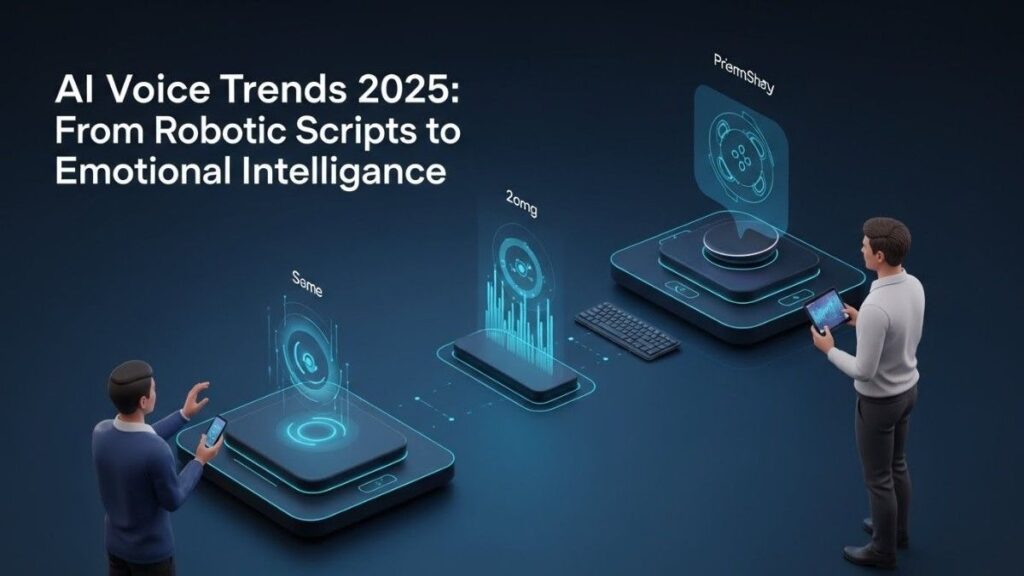
AI Voice Trends 2025: From Robotic Scripts to Emotional Intelligence
Introduction
Table of Contents
TL;DR The world of voice technology is changing fast. Gone are the days when AI assistants sounded like monotone robots reading from a script. The future of AI voice assistants is here, bringing emotional depth and human-like conversations into our daily lives. These intelligent systems now understand context, detect emotions, and respond with empathy. This shift marks a revolutionary moment in how we interact with technology.
Understanding the Evolution of Voice AI Technology
Voice AI has traveled a remarkable journey over the past decade. Early versions could barely understand basic commands. Users had to speak slowly and clearly, often repeating themselves multiple times. The frustration was real. Those clunky systems tested our patience at every turn.
Today’s voice assistants are completely different. They process natural language with impressive accuracy,catch subtle nuances in your tone. They even remember previous conversations to provide better context. This transformation didn’t happen overnight. Years of research, massive datasets, and advanced neural networks made it possible.
The technology behind modern voice AI relies on deep learning algorithms. These systems analyze millions of voice samples to understand speech patterns. They learn accents, dialects, and linguistic variations across different regions. The result is a more inclusive technology that serves diverse global populations.
Machine learning models now process emotions embedded in human speech. They detect frustration, happiness, confusion, and urgency. This emotional awareness allows the future of AI voice assistants to respond appropriately to user moods. A stressed caller gets a calmer, more supportive response. An excited customer receives matching enthusiasm.
The Shift from Scripted Responses to Dynamic Conversations
Traditional voice systems followed rigid scripts. They offered predetermined responses regardless of context. The conversation felt mechanical and impersonal. Users often felt trapped in endless menu loops with no escape route.
Modern AI voice technology breaks free from these constraints. Conversations flow naturally, adapting to each unique interaction. The system recognizes when someone needs quick answers versus detailed explanations. It adjusts its communication style based on user preferences and behavior patterns.
Dynamic conversation capabilities stem from advanced natural language processing. The AI doesn’t just recognize words anymore. It understands intent, sentiment, and context simultaneously. This multilayered comprehension enables meaningful exchanges that feel genuinely helpful.
The future of AI voice assistants prioritizes conversational flexibility over rigid protocols. Users can interrupt, change topics, or ask follow-up questions freely. The AI maintains context throughout these shifts, creating seamless dialogue. This approach mirrors how humans naturally communicate with each other.
Businesses implementing these dynamic systems see dramatic improvements in customer satisfaction. Call resolution times decrease significantly. Customers report feeling heard and understood. The technology handles complex queries that previously required human intervention.
Emotional Intelligence: The Game-Changing Feature
Emotional intelligence represents the biggest breakthrough in voice AI development. The technology now reads between the lines of what people say. It picks up vocal cues like pitch changes, speaking speed, and pauses. These subtle indicators reveal emotional states more accurately than words alone.
An emotionally intelligent voice assistant recognizes when a user sounds upset. It modifies its tone to sound more compassionate and patient. When someone expresses joy, the system responds with appropriate warmth. This emotional mirroring creates stronger connections between users and technology.
The implementation of emotional intelligence requires sophisticated algorithms. These systems analyze acoustic features in real-time during conversations. They cross-reference vocal patterns with linguistic content for comprehensive emotional assessment. The process happens in milliseconds, maintaining natural conversation flow.
Healthcare applications benefit enormously from emotionally aware voice AI. Elderly patients calling for assistance receive comfort alongside practical help. Mental health support services use emotionally intelligent systems for initial screenings. These applications demonstrate technology’s potential to provide genuine care and support.
Customer service departments leverage emotional intelligence to handle difficult situations. The future of AI voice assistants can de-escalate angry customers by responding with appropriate empathy. They recognize when to escalate issues to human agents based on emotional intensity. This smart routing improves outcomes for everyone involved.
Real-Time Language Processing and Multilingual Capabilities
Language barriers are crumbling thanks to advanced voice AI systems. Real-time translation allows seamless communication across different languages. A Spanish speaker can interact naturally with an English-based system. The conversation flows smoothly without awkward pauses or confusion.
Modern voice assistants support dozens of languages and hundreds of dialects. They switch between languages mid-conversation if needed. This flexibility serves our increasingly globalized world where multilingual interactions are common. Businesses expand their reach without hiring massive multilingual support teams.
The technology behind real-time language processing combines speech recognition with machine translation. These systems handle idiomatic expressions and cultural context, not just literal translations. They understand that direct word-for-word translation often misses the intended meaning.
Accent recognition has improved dramatically in recent years. The future of AI voice assistants accommodates regional variations without requiring users to modify their natural speech. Someone from Mumbai receives the same quality service as someone from Manchester. This inclusivity makes the technology accessible to billions more people worldwide.
Code-switching, where speakers mix multiple languages in one conversation, no longer confuses advanced systems. The AI recognizes language transitions and maintains contextual understanding throughout. This capability reflects how many people actually communicate in their daily lives.
Personalization Through Voice Biometrics and User Profiling
Voice biometrics adds a powerful security and personalization layer to AI assistants. Your voice becomes your password, unique as a fingerprint. The system recognizes you instantly without requiring manual login procedures. This frictionless authentication enhances both security and user experience.
Beyond security, voice recognition enables deep personalization. The future of AI voice assistants remembers your preferences, past interactions, and communication style. It learns whether you prefer brief answers or detailed explanations. It knows your favorite brands, typical requests, and personal schedules.
User profiling happens continuously as you interact with voice systems. The AI builds a comprehensive understanding of your needs and habits. It anticipates your requests based on patterns and timing. Morning interactions might differ from evening ones, and the system adapts accordingly.
Privacy considerations remain paramount in personalized voice AI systems. Users maintain control over their data and can delete their voice profiles anytime. Transparent data practices build trust between users and technology providers. This trust forms the foundation for long-term adoption and satisfaction.
Families benefit from multi-user voice recognition in shared devices. The system distinguishes between different household members automatically. Each person receives personalized responses tailored to their age, preferences, and access permissions. Parents control what content and features children can access through voice commands.
Industry Applications Transforming Business Operations
Healthcare organizations deploy voice AI for patient intake and appointment scheduling. Doctors use voice systems for hands-free medical documentation during examinations. Patients receive medication reminders through personalized voice calls. These applications reduce administrative burden while improving care quality.
Retail businesses integrate voice assistants into shopping experiences. Customers browse products, check inventory, and complete purchases using only their voice. Virtual shopping assistants provide personalized recommendations based on purchase history and preferences. The future of AI voice assistants makes shopping more accessible and convenient.
Financial services leverage voice technology for banking operations and fraud prevention. Customers check balances, transfer money, and pay bills through secure voice commands. Voice biometrics adds an extra security layer for sensitive transactions. Banks reduce call center costs while improving customer access to services.
Automotive manufacturers embed advanced voice assistants into vehicles. Drivers control navigation, entertainment, and vehicle settings without taking hands off the wheel. The AI understands natural commands like “I’m cold” and adjusts climate controls automatically. Safety improves as drivers maintain focus on the road.
Hospitality businesses use voice AI for guest services and room automation. Hotel guests control lighting, temperature, and entertainment through voice commands. They request services, ask questions, and provide feedback using in-room voice assistants. This technology enhances guest experience while reducing staff workload.
Voice Commerce and the Shopping Revolution
Voice commerce is exploding as consumers embrace hands-free shopping. People order groceries, reorder household essentials, and purchase gifts using voice commands. The convenience factor drives rapid adoption across demographic groups. Busy parents, elderly individuals, and multitaskers find particular value in voice shopping.
The future of AI voice assistants makes product discovery more intuitive and natural. Instead of typing keywords into search bars, shoppers describe what they need conversationally. The AI interprets these descriptions and suggests relevant products. This approach feels more like talking to a knowledgeable sales associate.
Security concerns around voice payments have decreased as authentication methods improve. Voice biometrics combined with multi-factor authentication provides robust protection. Users feel confident making purchases through voice commands. This confidence translates into growing transaction volumes.
Retailers optimize their voice commerce strategies by analyzing conversation data. They identify common pain points, popular products, and customer preferences. These insights inform inventory decisions, pricing strategies, and marketing campaigns. Voice interactions generate valuable business intelligence that improves operations.
Subscription services thrive in the voice commerce ecosystem. Users easily manage recurring orders, pause subscriptions, or modify delivery schedules through voice commands. The friction-free experience reduces subscription cancellations and increases customer lifetime value.
Integration with Smart Home Ecosystems
Smart homes rely heavily on voice AI as their primary control interface. Homeowners adjust lighting, temperature, security systems, and appliances using voice commands. The technology creates seamless living experiences where homes respond to residents’ needs automatically.
The future of AI voice assistants serves as the central hub connecting various smart devices. They coordinate actions across different systems for complex scenarios. A “goodnight” command might lock doors, turn off lights, adjust thermostats, and arm security systems simultaneously. This orchestration simplifies daily routines.
Energy management improves significantly through voice-controlled smart home systems. The AI learns usage patterns and optimizes energy consumption automatically. It suggests energy-saving measures based on behavior analysis. Homeowners reduce utility costs while minimizing environmental impact.
Accessibility features in voice-controlled homes benefit people with disabilities tremendously. Individuals with mobility limitations control their environment independently through voice commands. Visual impairments don’t prevent someone from adjusting settings or accessing information. This technology promotes independence and quality of life.
Home security systems integrate voice AI for enhanced monitoring and control. Homeowners check camera feeds, arm systems, and receive alerts through voice interactions. The AI recognizes unusual patterns and proactively notifies residents of potential security concerns. Peace of mind comes from knowing your home is intelligently protected.
Privacy and Security Challenges in Voice Technology
Privacy concerns remain a significant barrier to wider voice AI adoption. Many people worry about devices constantly listening to their conversations. Reports of accidental recordings being shared with staff raise legitimate concerns. Technology companies must address these fears transparently and proactively.
The future of AI voice assistants requires robust privacy protections built into their architecture. Local processing reduces data sent to cloud servers. Clear visual and audio indicators show when devices are actively listening. Users need granular controls over data collection, storage, and deletion.
Voice data represents sensitive biometric information requiring special protection. Hackers targeting voice profiles pose serious security risks. Stolen voice data could enable fraudulent access to accounts and services. Security measures must evolve as quickly as attack methods.
Regulations around voice data collection and usage continue developing globally. Companies must navigate complex legal requirements across different jurisdictions. Compliance costs increase but necessary for maintaining user trust. Ethical considerations should guide technology development beyond mere legal compliance.
Children’s interactions with voice assistants raise unique privacy concerns. Parental controls and age-appropriate content filters protect young users. The technology should help parents teach children about digital privacy and safety. Educational features can turn voice assistants into valuable learning tools.
The Role of AI Voice in Accessibility and Inclusion
Voice technology breaks down barriers for people with various disabilities. Individuals with visual impairments navigate digital services independently through voice interfaces. Motor disabilities that make typing difficult become irrelevant with voice commands. The technology enables participation in digital society for millions previously excluded.
The future of AI voice assistants prioritizes accessibility in design and development. Speech recognition accommodates various speech patterns, including those resulting from medical conditions. The systems understand slower speech, repetition, and non-standard pronunciation. This inclusivity ensures the technology serves everyone effectively.
Educational applications help students with learning disabilities access information more easily. Voice-based homework assistance supports different learning styles. Language learners practice pronunciation and receive immediate feedback. The technology adapts to individual learning paces and needs.
Elderly populations benefit enormously from voice-enabled services. Complex interfaces become simple voice commands. Seniors maintain independence longer by managing tasks through voice assistants. Social isolation decreases as voice technology provides companionship and connection.
Workplace accessibility improves through voice-enabled productivity tools. Employees with disabilities perform tasks previously challenging or impossible. Voice-controlled software, dictation tools, and hands-free communication options level the playing field. Companies benefit from diverse talent previously excluded by technological barriers.
Emerging Technologies Shaping Voice AI’s Future
Neural network architectures continue advancing, enabling more sophisticated voice AI capabilities. Transformer models process language with unprecedented accuracy and context awareness. These improvements make conversations feel increasingly natural and human-like. The technology gap between AI and human communication narrows rapidly.
Edge computing brings voice processing directly to devices rather than cloud servers. This shift reduces latency, improves privacy, and enables offline functionality. The future of AI voice assistants won’t depend entirely on internet connectivity. Local processing makes the technology more reliable and responsive.
Quantum computing promises to revolutionize voice AI processing capabilities. Complex calculations that currently take minutes could happen instantaneously. This speed enables real-time analysis of multiple data streams simultaneously. The technology remains experimental but holds enormous potential.
Augmented reality integration creates multimodal voice experiences combining visual and audio elements. Users interact with virtual objects through voice commands while seeing visual feedback. This combination enhances understanding and engagement. Smart glasses with voice AI create hands-free computing experiences.
Emotion synthesis allows AI to express emotions through voice output convincingly. The future of AI voice assistants won’t just understand emotions but convey them appropriately. Happy, concerned, excited, or apologetic tones match conversation context. This emotional expressiveness makes interactions feel more genuine and relatable.
Preparing Your Business for Voice-First Interactions
Companies must develop voice-first strategies to remain competitive in evolving markets. This approach prioritizes voice interactions in customer experience design. Traditional interfaces become secondary options rather than primary touchpoints. The shift requires rethinking how businesses connect with customers.
Voice user interface design differs fundamentally from visual interface design. Conversations flow linearly without visual navigation aids. Information architecture must support purely audio interactions. Designers create dialogue flows that feel natural while achieving business objectives efficiently.
Training staff to work alongside voice AI systems ensures smooth implementation. Employees learn when AI handles interactions versus when human intervention becomes necessary. This collaboration maximizes efficiency while maintaining quality. Staff focus on complex issues requiring human judgment and creativity.
Data infrastructure must support voice AI integration throughout business operations. Systems need APIs connecting voice interfaces to backend databases and applications. Real-time data access enables voice assistants to provide accurate, current information. Investment in technical infrastructure pays dividends through improved customer experiences.
Testing voice AI implementations thoroughly before full deployment prevents costly mistakes. Beta testing with diverse user groups reveals unexpected issues and opportunities. Continuous monitoring and improvement keep voice systems performing optimally. The future of AI voice assistants demands ongoing attention and refinement.
Voice Analytics and Business Intelligence
Voice interactions generate massive amounts of valuable data beyond traditional analytics. Businesses analyze conversation patterns, emotional trends, and customer sentiment at scale. These insights reveal pain points, product opportunities, and service improvements. Voice analytics transforms raw data into actionable business intelligence.
Sentiment analysis identifies customer satisfaction levels throughout interactions. Positive sentiment indicates effective service, while negative sentiment signals problems requiring attention. The future of AI voice assistants includes real-time sentiment monitoring that triggers appropriate responses. This capability prevents small issues from becoming major complaints.
Topic modeling discovers common themes across thousands of voice interactions. Businesses identify trending concerns, frequently asked questions, and emerging needs. This information guides product development, content creation, and support strategies. Voice data becomes a strategic asset driving business decisions.
Performance metrics for voice AI differ from traditional customer service measurements. Success includes conversation completion rates, resolution times, and user satisfaction scores. Businesses track these metrics to optimize voice system performance continuously. Data-driven improvements ensure the technology delivers maximum value.
Competitive intelligence emerges from analyzing how customers discuss competitor products during voice interactions. Businesses learn about alternative solutions customers consider. This knowledge informs positioning strategies and competitive responses. Voice analytics provides intelligence previously difficult or impossible to obtain.
Future Career Opportunities in Voice AI Industry
The voice AI industry creates diverse career opportunities across multiple disciplines. Conversation designers craft dialogue flows that feel natural and achieve business goals. These specialists combine linguistic knowledge with user experience design principles. Demand for skilled conversation designers grows as more companies adopt voice technology.
Voice user interface engineers build the technical infrastructure supporting voice applications. They work with speech recognition APIs, natural language processing engines, and cloud platforms. Strong programming skills combined with audio engineering knowledge make these professionals highly valuable.
The future of AI voice assistants requires specialists who understand emotional AI development. These researchers and engineers create systems that recognize and respond to human emotions. Psychology background combined with technical expertise produces ideal candidates for these roles.
Voice data analysts interpret the massive datasets generated by voice interactions. They identify patterns, measure performance, and recommend improvements. Strong statistical skills and business acumen help these professionals drive strategic decisions.
Quality assurance specialists test voice applications across diverse scenarios and user types. They ensure systems handle edge cases, understand various accents, and respond appropriately. Attention to detail and creative problem-solving define successful QA professionals in voice AI.
Frequently Asked Question
How Accurate Are Modern AI Voice Assistants?
Modern systems achieve over 95% accuracy in ideal conditions, while earlier versions struggled to reach 70%. Improvements come from better algorithms, larger training datasets, and more powerful processing capabilities. Accuracy continues improving as technology advances.
Can AI Voice Assistants Understand Emotions in Human Speech?
Yes, advanced systems detect emotional states through acoustic analysis. They recognize patterns in pitch, tone, speed, and rhythm that indicate emotions. While not perfect, the technology continues improving rapidly. Emotional understanding is a major focus area for developers.
Are Voice AI Systems Secure for Sensitive Transactions?
Security measures such as voice biometrics and multi-factor authentication protect sensitive interactions. Modern systems employ encryption and secure protocols throughout data transmission. Security remains a priority as voice commerce grows, though users should still exercise caution with highly sensitive information.
Will AI Voice Assistants Replace Human Customer Service?
Voice AI handles routine inquiries efficiently, but human representatives remain essential for complex situations. The future of AI voice assistants lies in collaboration between AI and humans. The technology augments human capabilities rather than fully replacing them, as empathy and creative problem-solving still require a human touch.
How Do Voice Assistants Protect User Privacy?
Leading providers implement local processing, data encryption, and user controls over information collection. Clear privacy policies explain data usage and retention practices. Users can delete voice recordings and opt out of certain features. Privacy protections continue to strengthen as regulations evolve.
What Languages Do Modern Voice Assistants Support?
Major platforms support dozens of languages and hundreds of dialects. Coverage expands continuously to serve global populations. Translation capabilities enable cross-language communication, and smaller languages are increasingly supported as technology becomes more accessible.
Can Businesses Customize Voice AI Solutions?
Absolutely. Custom voice AI applications address specific business requirements and brand identity. Companies can develop proprietary voice assistants or customize existing platforms. This flexibility allows businesses to create distinctive voice experiences aligned with their values and goals.
How Much Does It Cost to Implement Voice AI?
Costs vary widely based on complexity and scale. Small businesses may spend a few thousand dollars on basic implementations, while large enterprises can invest millions in comprehensive voice strategies. Cloud-based solutions provide affordable entry points with pay-as-you-grow pricing models.
Read More:-AI-Powered Follow-Up Systems for Sales & Support Teams
Conclusion

The transformation from robotic scripts to emotionally intelligent conversations marks a pivotal moment in technology history. Voice AI has evolved into sophisticated systems that understand context, recognize emotions, and communicate naturally. This progress opens incredible possibilities across industries and applications.
The future of AI voice assistants promises even more impressive capabilities. Emerging technologies will make interactions indistinguishable from human conversations. Businesses embracing voice-first strategies position themselves for success in this evolving landscape. Early adopters gain competitive advantages through enhanced customer experiences and operational efficiencies.
Privacy and security challenges require ongoing attention and innovation. Users deserve technology that respects their data while providing valuable services. Responsible development practices build trust essential for widespread adoption.
Accessibility benefits demonstrate technology’s potential to create a more inclusive world. Voice AI breaks down barriers that previously excluded millions from digital participation. This democratizing effect represents one of the technology’s most meaningful contributions.
The voice AI revolution has just begun. Systems will become more intuitive, more capable, and more integrated into daily life. Those who understand and leverage these capabilities will thrive in the coming years. The future sounds bright, conversational, and remarkably human.